Best-of-breed vs. all-in-one: How to choose the right tech stack for your firm



 Copied to clipboard.
A client signs the proposal. Now someone has to copy the details into the billing system, chase down a payment method, and follow up manually if the invoice goes unpaid. Three steps, two tools, and a gap where revenue slips. That disconnect is a stack problem, and it's one of the most common friction points accounting firms run into as they grow.
An all-in-one accounting platform bundles multiple functions, such as practice management, workflow, billing, and client communication, under a single vendor. A best-of-breed stack combines purpose-built tools instead, each one selected because it outperforms the equivalent bundled feature, connected through native integrations.
Neither model is inherently better than the other. The right answer depends on where your firm's workflow breaks down.
If you're evaluating this decision, you probably aren't starting from scratch. You already have clients and existing tools. This article gives you a criteria-based framework to assess both models and walks through a concrete firm scenario to show how the choice plays out in practice.
Key takeaways
- Firms with 30+ recurring clients and mixed billing models may find that all-in-one platforms create more manual overhead than they eliminate.
- Vendor lock-in can cost accounting firms more than convenience. It may block adoption of better billing and payment tools when they become available.
- The sharpest difference between all-in-one and best-of-breed accounting software shows up in the proposal-to-payment workflow.
- Integration overhead is a manageable risk when each platform in a best-of-breed stack connects natively to the accounting and workflow tools a firm already uses.
- Slower innovation in bundled tools can widen the gap between what all-in-one platforms offer and what purpose-built alternatives can deliver.
The decision accounting firms face
As your firm grows, you have to make a choice: whether proposals, engagement letters, billing, and payment collection operate as one automated revenue workflow or depend on manual handoffs between disconnected tools.
If you're managing 30+ recurring clients, mixed billing models, and engagement letter compliance obligations, that question has a direct cost. Every disconnect between a signed proposal and a collected payment is an opportunity for delays, unbilled work, or administrative drag.
In a CPA Practice Advisor podcast covering the benefits of adopting all-in-one accounting software suites versus technology stacks, practitioners who have tried best-of-breed stacks noted they "take an awful lot of work to make it all work together." That concern reframes the decision. The goal is to close the proposal-to-payment gap without creating new overhead. Firms that price and bill strategically need that gap closed reliably.
All-in-one platforms can still be the right fit for smaller or simpler firms. But once your firm outgrows that simplicity, the math changes.
All-in-one vs. best-of-breed: what each model means
An all-in-one platform bundles practice management, workflow, billing, and client communication under a single vendor. A best-of-breed stack connects purpose-built platforms through native integrations, where each tool is chosen because it outperforms the bundled equivalent in that specific workflow.
In practice, an all-in-one setup means one login for client records, task management, and invoicing. A best-of-breed setup uses connected specialist tools instead. The trade-offs between these models run deeper than convenience once your firm scales past a handful of clients.
The sharpest point of divergence is the proposal-to-payment sequence: what happens between sending a client agreement and collecting the first payment. That sequence exposes exactly where each model performs and where it falls short.
AI tools are reshaping this decision for firm owners.
Explore the top five AI tools accounting firms are using right now.
Where all-in-one platforms fall short
All-in-one platforms work well when a firm's needs are simple and uniform. Once you're managing recurring clients, mixed billing models, and engagement letter obligations, bundled features start to show their limits.
A few structural constraints drive most of the friction:
- Vendor lock-in that makes it costly to fix a single weak workflow
- Shallow features that can’t handle specialized proposal, billing, or collection needs
- Slower innovation in the tools your revenue depends on most

Vendor lock-in and what it costs your firm
Vendor lock-in costs your firm flexibility. Improving one weak proposal, billing, or payment function can mean rebuilding the entire client workflow, which is disruptive enough that most firms don't try.
That dependence preserves the manual workarounds you were hoping to eliminate.
Billing can't trigger automatically from a signed agreement. Engagement letters sit in a separate module with no connection to payment collection. Collections still need manual follow-up because the suite's design never automated that handoff.
Accounting firm automation only delivers its full value when those steps connect end to end.
Pricing exposure compounds the problem. Suite vendors carry escalating pricing risks at renewal that locked-in firms are poorly positioned to resist.
The clearest test of lock-in arrives when a better proposal or payment tool becomes available. A firm embedded in a suite can't adopt it without rebuilding its entire client workflow from the ground up.
Bundled features vs. purpose-built depth
A bundled proposal tool inside a practice management platform rarely connects a signed proposal to automatic billing and payment collection. That disconnect is where firms lose time and revenue.
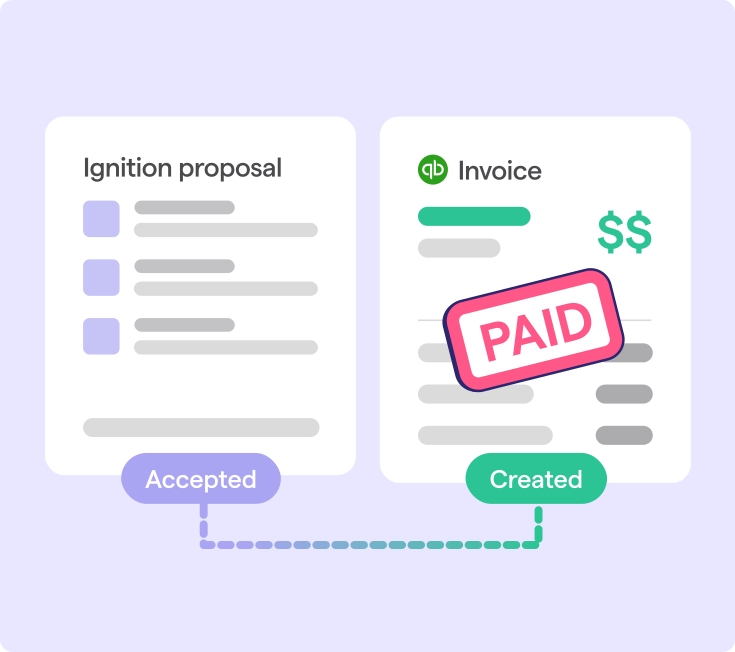
In Ignition, a signed proposal automatically triggers billing and payment collection in one connected workflow, eliminating the manual handoff, the separate invoice step, and the follow-up chasing payment details. That connected sequence is what purpose-built depth looks like across the full client lifecycle management process.
Firms want this kind of integration. Forty-five percent of small and medium-sized businesses (SMBs) want their payment systems to integrate with their accounting software, but only 35% of current systems provide that capability. That 10-point difference reflects exactly where bundled features fall short.
Slower innovation in essential tools
Suite vendors spread development resources across every bundled function, which means the tools that drive an accounting firm's revenue rarely get the focused attention they need to advance.
Ignition's AI Price Insights illustrates what focused development produces. The feature draws on real billing data from 8,500+ Ignition customers to generate personalized pricing benchmarks embedded directly in the proposal and renewal workflow.
A suite vendor building across practice management, document storage, and client communication can’t prioritize that depth in a single revenue function.
The pattern holds more broadly: IDC research found that the small and mid-sized businesses seeing AI results are activating capabilities embedded in their existing platforms.
AI embedded natively in a proposal-to-payment workflow surfaces at the moment a firm is setting prices or sending renewals. A suite feature added to a broad platform rarely reaches that level of precision.
The proposal-to-payment gap: why it matters most
The proposal-to-payment workflow is the highest-stakes layer of an accounting firm's tech stack, and it's where disconnected tools create the most damage. Every manual handoff between a signed proposal and collected payment is a point where billing stalls, cash flow slips, and administrative work compounds.
Eighty-one percent of surveyed SMBs using more than two billing or payment systems want to switch to an integrated solution. That signals fragmentation fatigue, but what SMBs want is integration depth. That doesn't have to mean a single vendor doing everything.
Ignition’s AutoCollect feature closes the gap between approval and payment automatically, with no manual chasing and no separate invoice run for outstanding balances imported from Xero or QuickBooks Online.
Around 78% of Ignition customers report reduced late payments because Ignition builds the payment ask into the engagement process instead of leaving it as a separate, often difficult client conversation.
All-in-one vs. best-of-breed: Which fits your firm?
Four criteria determine which model fits your firm:
- Client volume
- Billing variety
- Engagement letter compliance burden
- How much time your team spends chasing overdue payments
If your firm has fewer than 15 clients and uniform billing, like a single monthly retainer rate across a small roster, you can reasonably start with an all-in-one platform. The workflow is simple enough that bundled features cover the shortfalls without much friction.
The calculus shifts at 30+ recurring clients. At that volume, manual billing overhead becomes significant, especially when clients are on a mix of fixed retainers, variable fees, and project-based work. A bundled billing feature built to handle one billing type starts creating workarounds for the others.
Firms managing 100+ clients feel the engagement letter burden most acutely, particularly around tax season when bulk sending and renewal management can consume days of administrative work.
Persistent accounts receivable problems are the clearest signal of all. If someone on your team is manually following up on overdue balances each month, a purpose-built payment collection workflow will recover more time than any all-in-one feature set can.
How to build a best-of-breed stack that works
A best-of-breed stack works when every platform has a defined role and connects natively to the tools around it. Integration overhead is a selection problem. Choose platforms built for accounting firm workflows, and the overhead largely disappears.
The following categories cover the core revenue layer most firms need:
- Accounting: Xero or QuickBooks Online for bookkeeping, reporting, and reconciliation
- Workflow and practice management: Karbon for job tracking, team tasks, and client communication
- Payroll: Gusto for payroll processing and headcount data
- Proposals, engagement letters, billing, and payments: Ignition to connect client agreements directly to billing and payment collection
The depth of those integrations is what separates a functional stack from a manual one. Ignition's Smart Billing syncs with Gusto, Xero, and QuickBooks Online to auto-calculate variable charges based on headcount or usage, removing the spreadsheet step that typically sits between payroll data and a client invoice.
When evaluating any platform, the right question is whether it integrates natively with the tools your firm already runs, not how many tools the stack contains.
A firm scenario: 50 clients, Xero, Karbon, and Ignition
A 50-client firm can keep Xero and Karbon exactly as they are and add Ignition to handle everything between a new engagement and the first payment.
In practice, a prospective client receives a branded proposal through Ignition, signs digitally, and provides payment details at the same time. Billing triggers automatically at signing.
At tax season, pre-built templates generate engagement letters and send them out in bulk, removing manual document prep entirely. Because the firm collected payment authorization upfront, invoices never pile up waiting to be chased.
Ignition's native integrations with Xero and Karbon mean none of the firm's existing accounting or workflow processes change. Xero continues to handle reconciliation. Karbon continues to manage job tracking and team capacity. Ignition owns the proposal-to-payment sequence that neither platform was built to handle.
Consolidating into a single all-in-one platform would mean trading Karbon's workflow depth for a shallower alternative, losing the proposal and billing precision Ignition provides, and giving up the automated connection between a signed agreement and collected payment.
Best-of-breed pitfalls and how to avoid them
Best-of-breed stacks do carry risks, but they're manageable when you evaluate integration quality, vendor support, and onboarding demands before committing to a tool.
- Integration complexity is the most common concern. It's valid when a stack depends on middleware or custom API work to connect tools. It's far less relevant when platforms offer native connections to Xero, QuickBooks Online, MYOB, Gusto, and Karbon. Purpose-built integrations eliminate the fragility that made earlier best-of-breed stacks difficult to maintain, and they preserve the flexibility and specialization that make the model worth pursuing.
- Support fragmentation is easier to avoid than it sounds. Prioritize vendors with dedicated accounting firm support channels and active user communities. Specialized tools tend to attract specialized support teams, which often means faster, more relevant help than a generalist platform provides.
- Onboarding overhead shrinks considerably when platforms ship with pre-built resources. Ignition's industry-vetted engagement letter templates cut setup time for the proposal-to-payment workflow without requiring firms to build from scratch.
Build a stack that closes the gap and gets you paid
For firms managing 30+ recurring clients across a mix of fixed fees, variable billing, and engagement letter obligations, no single all-in-one platform closes the full loop from proposal to payment.
The firms that build around a best-of-breed stack, with purpose-built tools handling each layer, consistently come out with fewer manual steps, cleaner compliance records, and faster collections.
Build a stack that connects proposal to payment.
See how Ignition handles billing and payment collection automatically, so nothing falls through.
Frequently asked questions
-
A best-of-breed stack can create more admin work than an all-in-one platform, but the risk is specific to stack composition. Accounting firm practitioners have noted that best-of-breed tools "take an awful lot of work to make it all work together" when those tools rely on middleware rather than native integrations. The calculus shifts significantly when each platform connects natively to the tools a firm already uses, such as Xero, QuickBooks Online, Gusto, or Karbon, because native integrations eliminate the manual reconciliation that creates overhead in the first place.
-
Research suggests the friction point arrives sooner than most firms expect, with 81% of SMBs using more than two payment or billing systems reporting that they want to switch to an integrated solution. For accounting firms, the more useful diagnostic is whether a gap exists between where a client signs and where payment is collected. If those two steps happen in separate systems with manual handoffs between them, fragmentation is already costing the firm time and cash flow.
-
Switching does require deliberate migration planning, but purpose-built platforms with native accounting integrations are designed to layer into existing workflows. A firm already using Xero and Karbon, for example, can add a proposals-to-payments platform like Ignition without rebuilding its accounting or workflow layer, because the integration connects the new tool to existing client data and processes. The most time-intensive part of the transition is typically setting up proposal templates and engagement letter workflows, not re-onboarding the full client base.
-
Research suggests that 45% of SMBs want their payment systems to integrate with their accounting software, but only 35% of current systems offer that integration, meaning many firms are already paying for tools that do not close the gap they need closed. The more meaningful cost question for a firm evaluating its stack is the revenue lost to late payments, unbilled scope, and manual billing overhead that a disconnected or shallow stack fails to eliminate.
-
A best-of-breed approach may be the stronger path for AI adoption, provided the tools in the stack have AI embedded natively in their core workflows. IDC research across 2,700+ IT decision-makers found that SMBs seeing AI results are activating capabilities already embedded in their existing platforms.