The four revenue levers accounting firms ignore



 Copied to clipboard.
A firm adds a dozen new clients over the year, billing hours climb, and the team is stretched. Then the numbers come in, and margins are thinner than the year before. More clients, less money. It's a pattern that shows up more often than most firm leaders want to admit.
Revenue growth for accounting firms isn't only about winning new clients. It's also about recovering the revenue already being lost inside an existing client base through underpricing, unbilled scope, slow collections, and gaps in reporting.
Most firms treat growth as a client-acquisition problem. The instinct is to fill the pipeline, close more engagements, and scale headcount to match. But that skips a faster path: fixing what the firm is already losing before adding anyone new.
There are four specific operational levers where that leakage concentrates. Each one is diagnosable, and each one has a practical fix. This article lays out the framework so managing partners, firm owners, and operations leads can hold it against their own situation and see exactly where the losses are.
Key takeaways
- Recovering revenue from underpricing, unbilled scope, and slow collections may deliver faster results than acquiring new clients.
- Fee erosion happens gradually, so rates set years ago can fall significantly below market without triggering any client complaint.
- Firms that raise prices often retain clients at higher rates than expected, suggesting fear of pushback may outpace actual client resistance.
- Unbilled scope quietly becomes a write-off when there is no billing trigger at the moment out-of-scope work is identified.
- Disconnected proposal, billing, and payment data can hide which services are most profitable, making growth decisions harder to act on confidently.
Why most firms have a revenue recovery problem
The difference between what a firm should earn and what it actually collects is the growth constraint. It comes from four sources:
- Underpricing
- Unbilled scope
- Write-offs
- Slow or non-payment
Adding clients is the obvious growth lever, but it carries cost and risk. Recovering revenue from existing relationships is faster and lower-risk because the trust is already there.
Research indicates that accounting firms are increasingly focused on improving profitability within their current client base. While overall growth among North American firms dipped from 8.8% to 8.3% over the past year, net income growth rose from 8.1% to 10.4%.
The four levers that determine how much of that revenue a firm keeps are pricing, billing accuracy, collections, and reporting. Revenue operations tools can help address each one systematically.
Stop diagnosing revenue leakage manually
See how Ignition helps firms plug the leaks systematically
1. Pricing: the fastest lever firms underuse
Pricing is the one revenue lever that doesn’t demand new clients, new services, or operational changes. A firm with unchanged fees across an established client base is almost certainly earning less than its work is worth. The three sections below cover how to raise prices without losing clients, from spotting invisible undercharging to acting on benchmark data systematically.
How undercharging becomes invisible over time
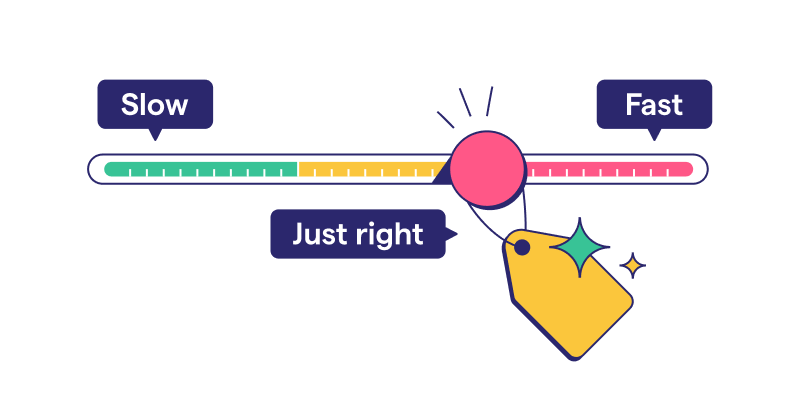
Fees set years ago and never revisited slowly fall behind rising costs and service complexity, making undercharging feel normal long before anyone notices. A rate that was competitive three years ago may now sit 15–20% below market.
The market would bear higher fees, but the firm never tests it for fear of client pushback. That fear usually outpaces actual resistance. Communicating your value clearly is often what makes a fee increase land well.
Using benchmark data to justify fee increases
Benchmark data replaces pricing instinct with a defensible reference point. According to the Ignition 2025 U.S. Accounting and Tax Pricing Benchmark, 80% of firms planned to raise prices by an average of 5–10% in 2026, and two-thirds of firms that raised prices in the past year lost no clients or maintained stable profitability. The fear of pushback is real, but the data doesn't support it.
AI Price Insights takes this knowledge further by surfacing how a firm's fees compare to peers for specific services, drawn from real billing data across 8,500-plus Ignition customers. That's a service-level comparison embedded directly in the proposal and renewal workflow.
See how your fees compare to peers
Get Ignition's 2025 U.S. Accounting and Tax Pricing Benchmark
Making price increases systematic, not stressful
Even firms that decide to raise prices often stall because updating fees across dozens of client agreements one at a time is slow and easy to defer.
AutoPricing removes that bottleneck by applying fee increases across multiple client agreements at once. Firms can push updated pricing in bulk at renewal, so increases go out consistently.
The practical result is that pricing stays current whenever costs rise or market rates shift, without triggering a firm-wide project each time.
2. Billing accuracy and scope creep losses
Billing errors and unbilled scope drain revenue silently. Unlike a lost client or a failed proposal, the missing amount never shows up as a visible loss on any report, so it persists unchallenged.
The problem runs in a predictable sequence. Variable and headcount-linked fees break down first, unbilled scope becomes a write-off, and connecting billing directly to signed agreements fixes both.
Where variable and headcount-linked fees break down
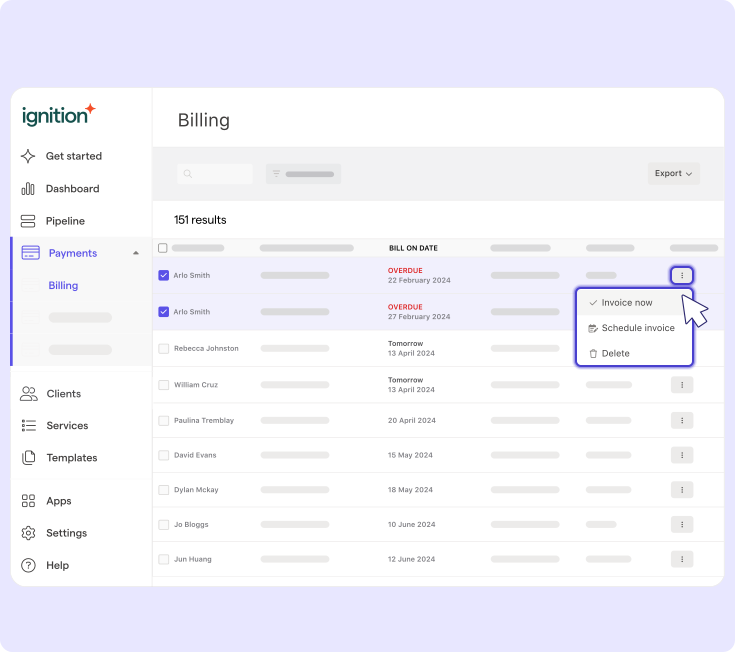
Manual variable billing creates a recurring chain of error-prone steps every single month. To bill a payroll-linked fee, someone on your team has to pull headcount data from Gusto, Xero, or QuickBooks, calculate the updated charge, and revise the invoice before it goes out. Each handoff is a point where the number can be entered incorrectly or the invoice delayed.
Ignition's Smart Billing removes that calculation step entirely. It syncs directly with Gusto, Xero, and QuickBooks to auto-calculate variable charges, so the right figure reaches the invoice without manual input. If you're still creating invoices manually for headcount-based clients, the margin loss from errors and delays adds up faster than most firms realize.
How unbilled scope becomes a write-off
Out-of-scope work becomes a write-off through a predictable sequence:
- The team completes extra work.
- It hesitates to raise an awkward billing conversation.
- It eventually absorbs the cost as a goodwill gesture.
Vague or unenforced engagement terms accelerate this. When the original agreement doesn't define what falls outside scope, there's no clear trigger to bill for additional work. The longer that sits, the harder the conversation feels, and the more likely the charge disappears entirely.
Ignition's Instant Bill feature closes that window. When additional work is identified, teams can generate a charge immediately, before hesitation sets in, converting a likely write-off into a billable event.
Connecting billing directly to signed agreements
Most billing errors trace back to one structural flaw: The engagement letter and the invoicing tool are separate systems. When scope is agreed in a proposal, then manually re-entered into a billing platform, the fee, service description, or billing schedule can drift at every step.
Ignition Billing removes that disconnect entirely. The proposal becomes the contract, and the contract drives billing directly, so what was agreed on in the client meeting is exactly what appears on the invoice, with no manual re-entry between signed scope and the amount billed.
3. Collections and days sales outstanding
Days sales outstanding (DSO) measures the average number of days between issuing an invoice and receiving payment. A high DSO means revenue the firm has already earned is sitting uncollected, creating a cash flow shortfall that new client growth alone can’t close.
The sections below cover what that shortfall costs, how upfront payment authorization resets the collection model, and how automation handles the burden at scale.
What a high DSO actually costs your firm
Every day an invoice sits unpaid is a day the firm has delivered work it can't reinvest, pay staff with, or use to fund growth.
A firm carrying a 45-day DSO on $600k in annual revenue has roughly $74k in earned but uncollected revenue sitting idle at any given time. That's capital the firm has already worked for and can't deploy.
The secondary cost compounds that problem. Manual follow-up on overdue invoices consumes staff time that could go toward billable work or building client relationships.
Upfront payment authorization as a collections reset
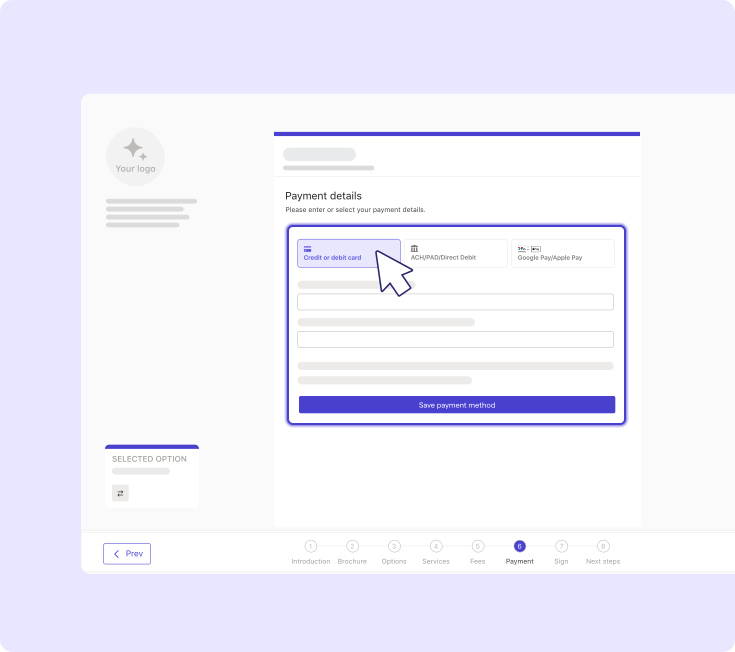
Collecting payment authorization at proposal signing removes the invoice-then-chase cycle that drives high days sales outstanding in the first place. When a client signs, the payment conversation is already done.
Ignition's Payments and Collections product captures payment details at the moment the proposal is accepted, pre-authorizing future charges before work begins. There's no invoice to send, no follow-up email to write, and no waiting on client action after delivery.
Because the payment ask happens once, at the start of the engagement, it stays out of the ongoing client relationship entirely. Around 78% of Ignition customers report reduced late payments as a direct result of this model.
Automating collection for 30-plus recurring clients
Manual invoice follow-up is manageable for a handful of clients. Past 30 recurring accounts, it becomes a part-time job that pulls staff away from billable work.
AutoCollect solves this by importing outstanding invoices from QuickBooks Online or Xero directly into Ignition's automated collection workflow. Existing invoice backlogs enter the same system as new client agreements, so nothing sits outside the process waiting on a manual chase.
The team stops sending payment reminders, and the firm's cash position starts reflecting work already completed.
4. Revenue visibility and real-time reporting
Connected reporting makes pricing, billing, and collection problems visible in real time. A firm can only act on what it can measure. With proposal, billing, and payment data sitting in separate systems, that visibility rarely exists.
What follows covers why disconnected data hides profitable services, how a consolidated view changes daily decision-making, and where real-time reporting points toward the next growth move.
Why disconnected data hides profitable services
Disconnected proposal, billing, and payment records hide service profitability because calculating which services generate the most revenue takes a manual reconciliation project before a single insight appears.
A firm juggling separate proposal, invoicing, and payment tools can't see, in real time, which service lines are growing or which invoices are aging.
Ignition's Business Insights Dashboard removes that friction by tying reporting directly to live proposal, billing, and payment data. Insights update automatically as clients sign and payments progress, without manual data pulls.
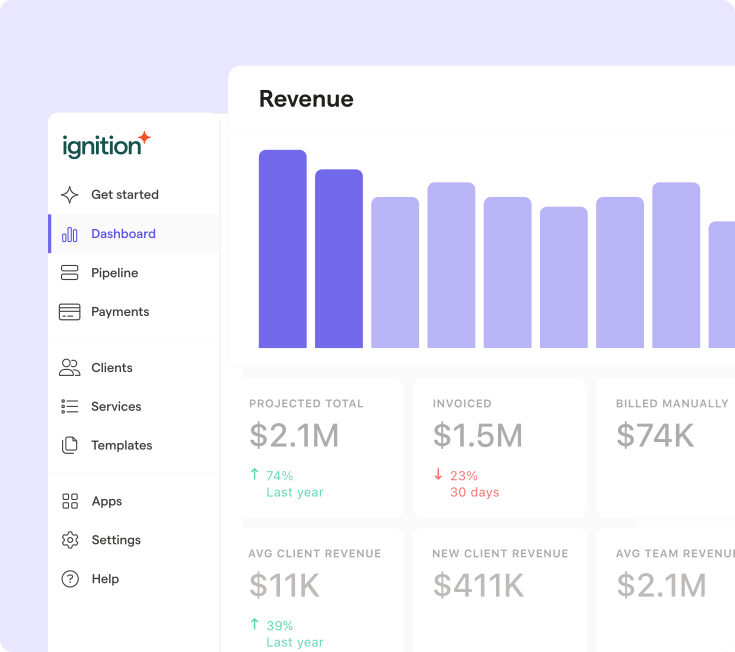
Tracking pipeline, billing, and payments in one view
A consolidated view lets a managing partner see projected revenue, proposal status, and payment progress without switching between platforms. The Business Insights Dashboard surfaces:
- Projected revenue as clients sign
- Collected and pending payments
- Sent and accepted proposals with response times
- Revenue broken down by service
That real-time visibility changes how a firm owner manages a team. When proposal response times slow or a deal stalls, the dashboard flags it early enough to act. Without it, that problem only becomes visible at month-end, after the opportunity to intervene has passed.
Using reporting to find the next growth decision
Real-time service revenue data identifies which offerings to expand, which to reprice, and which clients are ready for an upsell conversation, without waiting for a quarterly review.
If the Business Insights Dashboard shows advisory retainers generating 30% higher monthly recurring revenue than compliance-only engagements, that single data point drives concrete decisions:
- Build a new proposal template.
- Adjust the pricing tier.
- Identify which compliance-only clients to approach first.
Pair those insights with an AI pricing strategy blueprint, and the next growth move becomes clear before the quarter closes.
How the four levers work together
The four levers covered in this article aren't independent fixes. Pricing sets the right fee, billing accuracy makes sure the right amount gets invoiced, collections convert that invoice to cash, and reporting shows where each of those steps is breaking down. Pull only one while ignoring the others, and the leakage continues, just from a different source.
The fastest path to revenue growth for most firms is recovering what's already been earned but not captured inside the existing client base, through tighter operational controls that work together as a system.
Ignition connects all four of those controls in one platform, linking pricing benchmarks and proposal workflows to automated billing, upfront payment collection, and real-time reporting across every client engagement.
Ready to recover revenue from your existing client base?
Ignition connects pricing, billing, collections, and reporting in one platform.
Frequently asked questions
-
The accounting sector offers meaningful context. North American firms saw overall growth slow from 8.8% to 8.3% over the past year, while net income growth increased from 8.1% to 10.4%. Individual firm performance varies widely, and the difference between average and top-performing firms consistently points to operational discipline as a primary driver of revenue growth.
-
Advisory services generally generate stronger margins than compliance-only work because they carry higher perceived value relative to the hours involved. Services like strategic tax planning, outsourced CFO support, and ongoing business advisory are consistently cited by practitioners as the highest-margin offerings in a firm's portfolio. Firms that track revenue by service type are better positioned to identify which offerings to expand and which to reprice.
-
Realization rate is the percentage of billable fees a firm actually collects, calculated as collected revenue divided by total billable value. A realization rate below 85% typically signals significant revenue leakage from write-offs, scope creep, or billing inefficiencies that no new-client strategy can offset. Improving realization rate is often a faster path to revenue growth than adding clients, because it recovers money from work already delivered.
-
Four operational levers can recover revenue from an existing client base: raising fees to market rates, eliminating unbilled scope, reducing days sales outstanding, and using real-time reporting to identify which services generate the most profit. Ignition's 2025 U.S. Accounting and Tax Pricing Benchmark Report found that two-thirds of firms that raised prices lost no clients or maintained stable profitability. Fixing these internal gaps takes no marketing spend and no new sales capacity, making it the lower-risk growth path for most firms.
-
Pricing is the fastest lever to pull, since it takes no new clients, no new services, and no operational overhaul, only a decision to charge fees that reflect current market rates. Benchmark data helps here: 80% of accounting firms planned to raise prices by an average of 5–10% in 2026, per Ignition's 2025 pricing benchmark report. Once pricing is addressed, billing accuracy and collections are the next priorities, since unbilled scope and slow payment erode the revenue a fee increase is designed to capture.