How to price confidently with data clients trust



 Copied to clipboard.
“Let’s just charge what everyone else is charging.”
It sounds like a safe approach when pricing client services. But in practice, it creates more uncertainty than confidence. You don’t know what’s included in competitor pricing, how extra work is handled, or whether those prices accurately reflect the scope of the work.
That gap shows up quickly. Scope expands, small requests get absorbed “because it’s quick,” and work quietly turns into write-offs. When it’s time to revisit pricing, the conversation feels reactive and hard to justify.
The solution is simple: use the customer data you already have to price accurately and build trust with your clients.
This article outlines practical, data-driven pricing strategies using insights you can already access: analyzing activity for existing clients, assessing workload before onboarding new clients, and using that data to support clearer pricing conversations.
Ignition’s AI-powered Price Insights support this process by embedding data-backed recommendations directly into proposal workflows, helping service-based businesses price based on real activity, scope, and complexity.
Key takeaways
- Stop major revenue leakage by using delivery data to continuously validate scope and pricing.
- Raise fees with less pushback by showing clear changes in activity and volume instead of relying on intuition.
- Price new clients more accurately by assessing data quality and transaction volume before you propose.
- Protect margins by using a multi-factor approach that considers the consumer price index (CPI), scope, complexity, volume, and cleanup needs.
- Reduce write-offs by implementing a consistent out-of-scope protocol that communicates pricing upfront and bills systematically.
Use activity data to stop the write-off cycle
Ad hoc requests often sneak into day-to-day work and still get handled without much thought. Over time, those small tasks add up and quietly turn into write-offs that erode margins.
This is where benchmarks fall short. They assume a stable scope and rely on market demand signals instead of reflecting the work being delivered. As client activity changes, that gap grows, leading to underpriced work and recurring write-offs. That’s why pricing confidence comes from service delivery data.
Tools like Ignition’s AI-powered Price Insights help bring that data into the pricing process by surfacing relevant signals at the moment decisions are made. With clearer visibility into activity, teams can price more consistently and have more grounded conversations about scope and fees.
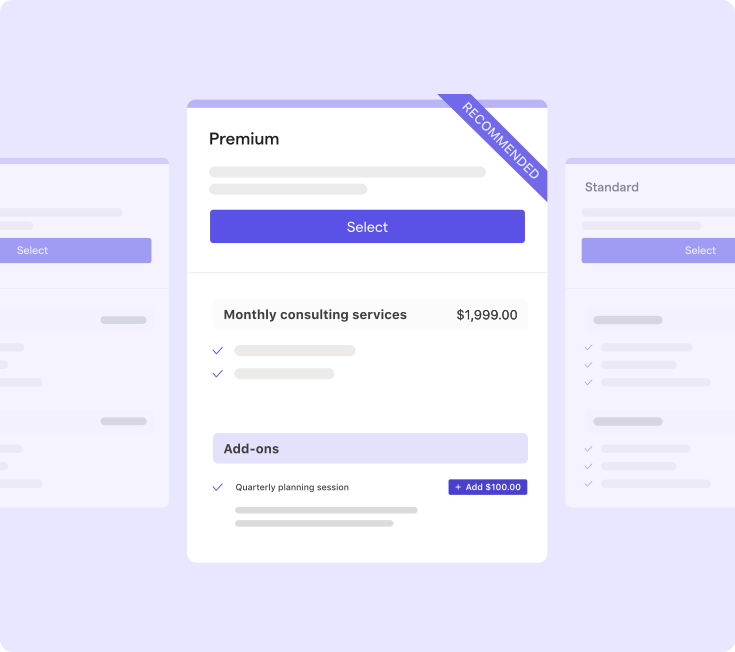
The activity count method for data-driven pricing optimization
The simplest way to turn delivery data into pricing decisions is to track how work compares to what was originally scoped. This creates a clear, repeatable way to spot where scope is drifting and take action before it impacts margins.
Step 1: Compare what you scoped versus what you delivered. Tracking estimated versus actual hours in real time shows whether work is staying within scope and highlights where time is increasing. It also helps teams respond to fluctuations in client activity. Over time, this reveals patterns behind slower or more complex periods.
Step 2: Use a quarterly volume analysis to catch changes early and forecast proactively. When activity increases consistently, it’s a signal that scope may no longer match the work being delivered, and a pricing conversation may be needed.
Step 3: Review historical data. Look at where you’ve gone over, where you’ve come in under, and what areas are taking longer than expected.
Step 4: Use these insights to update scope and pricing and align your services with the current level of work.
Move from reactive to proactive scope monitoring
Most pricing issues don’t come from one large change. They build gradually as scope expands without being reviewed. By the time it’s addressed, the gap between work and pricing is already significant.
A proactive approach shifts that dynamic by identifying changes earlier and addressing them before they impact margins.
Old way |
New way |
Benchmarking based on market trends | Pricing informed by real delivery data |
| Scope creep goes unnoticed | Ongoing scope visibility and monitoring |
| Annual billing shock | Regular, proactive adjustments |
| Reactive conversations about price changes | Continuous, evidence-based conversations |
| Revenue left on the table | More predictable cash flow |
To make this shift effective, define clear triggers for when pricing should be reviewed, such as spikes in volume, changes in complexity, or repeated out-of-scope requests. Earlier conversations are typically easier and more effective than waiting until the gap becomes too large.
Ignition helps make scope visible and easier to manage throughout the client lifecycle. Structured service templates, built-in agreements, and streamlined billing for additional work keep teams aligned on deliverables and make it easier to adjust pricing in a consistent, timely way.
Price accurately from day one with pre-engagement data
Data-driven pricing starts before the engagement is signed. A clear, repeatable intake process helps you assess workload upfront and set pricing that reflects the reality of the work.
A simple workflow:
- New client arrives
- Review data quality and workload signals
- Scope services and pricing in Ignition
- Propose fixed fees with clear assumptions
New client pricing checklist you can run in under an hour
When creating a pricing strategy for a new client, run a quick operational check to understand how much work the engagement will require.
- Assess the data quality: Look for cleanup indicators such as duplicate transactions, unreconciled accounts, or long reconciliation gaps. These signal whether a cleanup project should be scoped first.
- Evaluate transaction volume: Review how much activity the client has and whether it’s stable or volatile. This helps set realistic workload expectations and pricing.
- Identify complexity drivers: Consider factors that increase effort, such as payroll and headcount, multi-entity structures, and recurring reconciliation issues.
- Adjust scope and packaging: Use these insights to refine the engagement, whether that means adding a cleanup project, scoping advisory work, or creating a package tier.
What to avoid: Don’t default to temporary hourly billing just because the lead is unknown. While it may feel like a safe fallback, it delays scoping and pricing decisions.
Use data to justify fee increases and bill out-of-scope work
Data isn’t just an internal management tool. It’s the backbone of calmer, faster pricing conversations.
When fee increases are tied to clear operational signals like higher transaction volume, increased client activity, or additional deliverables, the discussion becomes less subjective. Instead of introducing a different price without justification, the conversation shifts to the workload behind it, making the change easier to explain and far less personal.
Present data to clients using a simple script
Price increases are hardest to explain when there’s no clear proof. Without data, conversations often drift into questions like “Why does this take so long?”
Grounding the discussion in measurable changes such as transaction volume, time spent resolving exceptions, or added complexity keeps the focus on the work, not the price.
A simple way to structure the conversation:
1. Introduce the review: “We periodically review client activity to make sure scope and pricing stay aligned.”
2. Show the data: “Over the past year, your transaction volume has increased, and we’re seeing more reconciliation exceptions.”
3. Connect it to effort: “That change increases the time required to support your account.”
4. Propose the adjustment: “We’re updating the monthly fee to reflect the current level of work.”
Used this way, reporting becomes a sales tool that helps explain pricing changes clearly and confidently.
Systematize out-of-scope billing so ad hoc work stops leaking revenue
Scope creep is easier to manage when there’s a clear process for handling additional work.
- Step 1: Identify the request: When a client makes a request, confirm whether it’s included in the agreed scope before moving forward.
- Step 2: Communicate pricing upfront: If it’s out of scope, state that clearly and outline any additional fees before the work begins.
- Step 3: Bill it consistently: Add charges through a standard process rather than relying on one-off invoices. Tools like Ignition can streamline this with structured agreements and automated billing.
- Step 4: Track the requests: Document out-of-scope work to inform future pricing and repricing decisions.
Turn pricing into a habit with scorecards and a multi-factor review cycle
Tracking and regular review keep this approach consistent. Without a defined cadence, teams tend to fall back on reactive pricing or default to CPI-only adjustments.
A structured review process keeps pricing aligned with the work being delivered and ensures adjustments are based on data, not guesswork.
Build the three-month and 12-month pricing review cycle
Pricing works best with a clear cadence. Quarterly check-ins help teams spot early signals like rising transaction volume or recurring out-of-scope requests before they erode margins.
Mid-engagement triggers such as scope changes or increases in complexity should prompt a review.
When anchored by Ignition’s activity count report, the annual review becomes a structured repricing moment.
Go beyond CPI with a multi-factor pricing formula
CPI-only increases often miss the real drivers of work, such as volume, complexity, scope changes, and data quality issues. As a result, they fail to protect profit margins and create misalignment between scope and price.
Instead, use a pricing formula that starts with CPI and adjusts based on additional factors:
- Baseline CPI: starting point for routine increases
- Volume changes: transaction or activity spikes
- Complexity factors: payroll, multi-entity structures, exceptions
- Scope changes: additions or reductions
- Data quality issues: cleanup needs, alerts, messy records
Create a client profitability scorecard your team reviews monthly
By tracking client activity and workload, you can turn data into decisions and make proactive pricing adjustments instead of reacting after the fact.
Scorecard categories should reflect how work is delivered, including:
- Bookkeeping: transaction volume, reconciliations, and data quality alerts
- Payroll: headcount, complexity, and exceptions
- Advisory and reporting: ongoing support, reporting requirements, multi-entity, or intercompany activity
Use this scorecard to guide a monthly pricing review conversation with your team:
- Review scorecard data and flag outliers
- Identify clients trending beyond scope
- Determine which out-of-scope projects should be created
- Flag clients who need a pricing conversation
Used consistently, this process keeps your team aligned, surfaces scope creep early, and helps you adjust pricing before margins are impacted.
Put Ignition to work for confident, data-driven pricing decisions
Pricing becomes easier when it’s grounded in real delivery data. By tracking activity, reviewing scope regularly, and using data to guide decision-making, you can move away from reactive adjustments and toward a consistent, repeatable pricing approach. Instead of relying on benchmarks or gut feel, you can set prices that reflect the true effort, complexity, and value of your services, creating a stronger competitive advantage.
Ignition brings this data-driven approach into your day-to-day workflows. With AI-powered Price Insights embedded directly in proposals, along with end-to-end visibility across scope, billing, and payments, teams can set prices more confidently and implement changes without friction. Structured agreements, automated billing, and upfront payment collection ensure that pricing decisions translate into predictable cash flow and support your broader business strategy.
Make more confident, data-driven pricing decisions
Use Ignition to bring structure to your pricing, from proposal to payment.
FAQs
-
Start by choosing one reliable source of truth for what you scoped and what you delivered, then review it on a consistent cadence. Compare estimated effort to actual effort to pinpoint which clients or services are drifting out of scope. Use that evidence to adjust scope and pricing for the next period rather than guessing. Keep the first pass simple so it becomes a repeatable habit.
-
Show the simplest proof that connects to what the client experiences, such as increased activity, higher volume, or more time spent due to additional requests. Keep the conversation focused on what changed and what will change going forward. Use the data to explain the rationale, then present the updated price as a fair reflection of the current engagement. This makes the change feel objective rather than arbitrary.
-
Review the information you’ve collected about the client before creating a proposal to identify cleanup signals and complexity proactively. Use those findings to scope a cleanup component (if needed) or adjust the ongoing fee to reflect the current condition of their books. Avoid using a temporary hourly period as a substitute for scoping, since it delays clarity for both sides. Build clear assumptions into the proposal so both you and the client know what “normal” looks like.
-
CPI is only one input, and it ignores engagement-specific changes like transaction growth, added scope, and increased complexity. When client activity increases, a CPI-only adjustment can leave you underpriced and absorbing extra work. A multi-factor approach allows you to adjust up or down based on what truly changed, making pricing easier to defend.
-
Create a consistent protocol for identifying requests that sit outside the agreed scope and communicate pricing before you do the work. Use a standardized way to bill those requests so they don’t get lost in ad hoc invoicing. Track these requests so you can revise the base scope or package at the next review. Over time, this turns scope creep into a managed, billable workflow.
-
Use an annual review as your baseline, and add a three-month checkpoint for new clients or any engagement where activity changes quickly. Watch for triggers like higher transaction volume, repeated exceptions, or frequent add-on requests. Earlier conversations are usually easier than waiting until the gap becomes too large. A consistent cycle also reduces friction by making repricing expected and routine.