What belongs in a service description template?



 Copied to clipboard.
Most firms don't lose margin because of bad clients. They lose it because of vague paperwork. A monthly bookkeeping client assumes cleanup work is included. A consulting client expects a fourth revision round. A tax client sends documents two weeks late and still expects the original filing date. None of these situations start as disputes. They start with service descriptions that weren’t specific enough when the engagement was signed.
Getting the language right before work begins is one of the most practical things a firm can do to protect revenue, reduce back-and-forth, and make billing feel automatic rather than adversarial. That means knowing exactly what belongs in a service description and how to write one that holds up across both recurring retainers and fixed-scope projects.
What follows is a practical guide to the structure, wording, and reusable patterns that make service descriptions do their job: defining the work, setting client expectations, and connecting cleanly to payment.
Key takeaways
- A strong professional services description template defines scope, deliverables, timelines, client responsibilities, and exclusions so both sides understand exactly what’s included.
- Recurring service descriptions need different language than project-based work because billing cadence, deliverables, and client expectations often change across ongoing and one-time engagements.
- Including an out-of-scope clause in a professional services description template can help firms reduce scope creep and create a clearer path for change orders.
- Payment terms belong inside the service description template because clear fees, billing timing, and collection terms help reduce late payments and manual follow-up.
- Building a reusable library of professional services description templates can support faster proposals, more consistent client communication, and cleaner billing automation across the firm.
The core components of a professional services description template
A strong service description defines the work, sets client expectations, supports accurate billing, and protects your margin. Miss any one of those elements, and you're exposed to scope creep or delayed payments.
Every service description should include:
- Scope of services: Exactly what's included and what’s excluded.
- Deliverables and timelines: Specific outputs, when clients should expect them, and pricing and billing terms.
- Client responsibilities: What the client must provide to keep the engagement on track.
Scope of services
Vague labels like "advisory" or "support" leave clients guessing and create room for scope creep. Replace them with specific actions that describe exactly what you'll deliver.
Instead of "bookkeeping services," write "monthly bank reconciliations, transaction categorization, and preparation of a profit and loss statement." That rewrite tells clients what they're buying and your team what they're committing to.
Action: Audit one existing service description by replacing every generic noun with a specific action and deliverable.
Out-of-scope clause
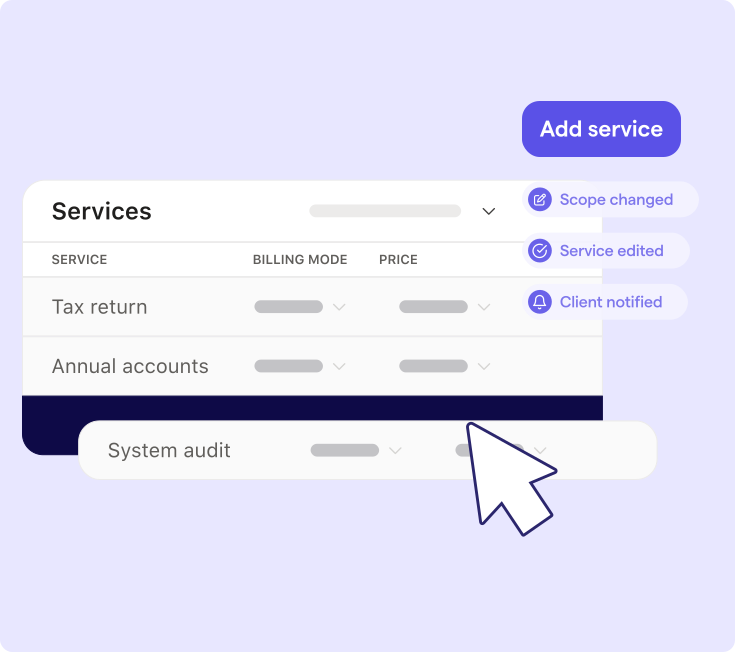
Place this clause directly after your deliverables list. Name what's excluded, such as amended tax returns, additional entities, cleanup work, or extra revision rounds. Then explain how new requests will be approved and billed as change orders.
Without that process, those requests become unpaid favors that quietly erode your margin.
Action step: Identify your three most common out-of-scope requests and convert each into a template exclusion with a documented approval and billing process.
Deliverables and timelines
Each deliverable in your template needs a paired cadence, date, or milestone rather than just a description. For recurring services, specify the frequency directly: monthly management reports delivered by the fifth business day of each month.
For project work, break outputs into phases with defined review points, such as a consulting roadmap delivered in three stages with client sign-off before each billing trigger.
Clearer timing reduces disputes and creates billing triggers that are easier to defend and automate.
Client responsibilities
Your engagement letter should specify exactly what the client must provide and when. For example, require bank statements and supporting documents within five business days of month-end and designate one point of contact to approve deliverables within 48 hours.
Without these expectations, timelines slip quickly. A bookkeeping client who delivers bank statements two weeks late pushes your close date and the work scheduled behind it. Practice assurance reviews examine engagement documentation, so this clause supports both delivery and compliance.
Recurring vs. project-based service descriptions: Why the language must differ
Recurring and project-based services bill differently, so their descriptions should reflect that from the start.
A monthly bookkeeping retainer should emphasize cadence, continuity, and what's included in each billing cycle. For example: "Monthly reconciliation and financial reporting delivered by the fifth business day of each month." That language supports automated billing without ambiguity.
A fixed-scope consulting engagement needs milestone language that defines deliverables, completion criteria, and what triggers final payment. "Strategic CFO review delivered within 30 days of kickoff" tells both parties exactly when the work ends.
Use this as your decision rule:
- Ongoing access or recurring cadence? Write for continuity with billing cycles, included tasks, and renewal terms.
- Defined outcome? Write for completion with scope boundaries, deliverables, and payment triggers.
Getting this right reduces approval delays and keeps automated billing running cleanly, without back-and-forth over what was promised.
How a well-structured service description prevents scope creep
Scope creep rarely starts with a difficult client. It starts with ambiguous wording in your proposal.
When a client assumes historical bookkeeping cleanup is included in their monthly package, they're not being unreasonable. They're filling in a gap you left open, and that gap costs you hours you'll never bill for.
A strong service description clearly defines what’s included, what’s excluded, what the client is responsible for, and how additional work will be approved.
For a consulting engagement, that means stating "two revision rounds included" rather than leaving revision expectations unspoken. Undefined scope doesn't just create disputes. It erodes the margin on work that should be profitable.
Payment terms belong inside the service description

Placing payment terms next to your scope lets clients see the full commercial commitment before they sign, not after friction starts.
For every service, include four things: the fee amount or pricing basis, billing cadence, accepted payment method, and what happens if work pauses because client inputs arrive late.
A recurring bookkeeping engagement, for example, should state the monthly flat fee, upfront payment authorization, and a clear pause clause if bank access is delayed. A consulting project should specify milestone billing tied to defined deliverables rather than calendar dates.
Late payments disproportionately affect small businesses, and regulatory pressure around payment practices is growing. Vague payment language creates unnecessary cash flow risk.
Industry-specific service description examples
Recurring (bookkeeping): "Monthly bookkeeping includes bank reconciliation, expense categorization, and a monthly profit and loss statement. Excludes payroll and tax filings. Billed automatically on the first of each month."
Project (tax): "Preparation and filing of your federal and state returns for the current tax year. Excludes amended returns. Payment due upon engagement acceptance."
Bookkeeping and tax preparation
A strong engagement letter for this service combination separates the two scopes clearly. Monthly bookkeeping covers categorization, reconciliation, and financial reporting, provided the client submits source documents by the agreed deadline. Annual tax preparation covers federal and state filing for the agreed entity type.
Exclude cleanup work by name. Historical cleanup or prior-period corrections are billed separately at your hourly rate. That boundary protects revenue and sets clear expectations upfront.
Collect payment authorization before work begins. Quality management standards reinforce the importance of clear engagement documentation for managing risk. This structure becomes more than an administrative preference. It supports consistent client engagements.
Fractional CFO or advisory retainer
Advisory retainers require more precise language than project work because the value is ongoing access rather than a single deliverable.
A description for a growing business might read: "Monthly finance review (one 60-minute meeting to review management reports and KPIs) plus a quarterly planning session (90 minutes covering forecasting and priorities). Payment is due on the first of each month."
The description should also state what's excluded, such as audit, legal, and investment advice. Set response time expectations for ad hoc questions between sessions.
That specificity protects both parties and prevents retainers from becoming unlimited support arrangements.
Consulting project engagement
Fixed-scope consulting work needs milestone-based billing instead of monthly invoices. Tie each payment to a defined deliverable so collections are never ambiguous.
A practical three-phase structure looks like this:
- Phase 1 – Discovery: Four stakeholder interviews; invoice triggered upon written sign-off.
- Phase 2 – Strategic recommendations: Slide deck delivered; invoice triggered upon client approval.
- Phase 3 – Final presentation: Live session completed; final invoice triggered upon delivery.
Include a revision limit of two rounds per phase and a change request clause stating that additional scope requires a new proposal before work begins. This protects your margin without creating unnecessary friction.
How to build a reusable service description library for your firm
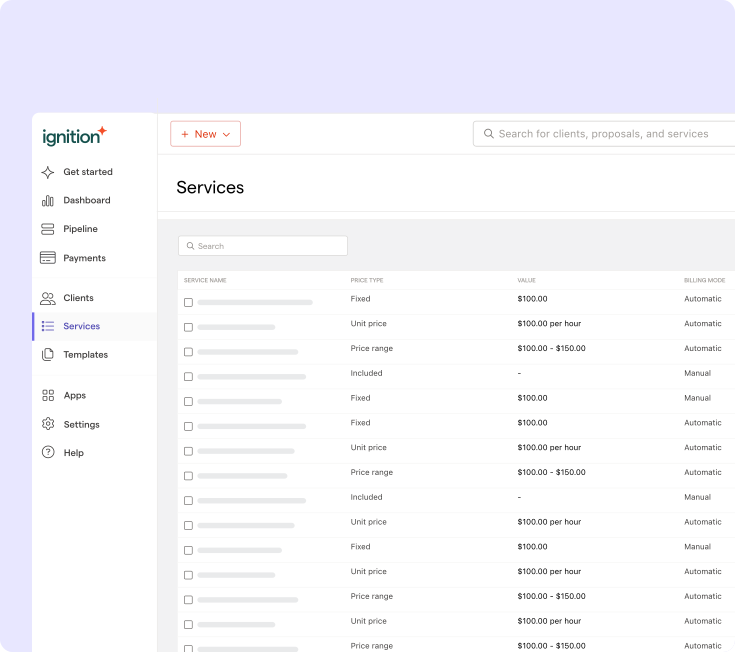
Start by pulling your existing invoice descriptions and proposal templates. Those are your raw materials. Sort them into three buckets: recurring services, project-based engagements, and add-ons.
For example, a firm offering monthly bookkeeping, individual tax prep, fractional CFO services, and one-time consulting needs distinct descriptions for each. Organize them by service line and billing model so teams can mix and match without rewriting scope.
Use AI tools to draft first versions faster, then review each for accuracy, compliance, and tone. Once polished, each entry becomes a reusable asset. Pair this approach with tiered pricing templates to build proposals that are consistent, fast, and scalable.
Turn your service descriptions into automated billing with Ignition
A well-written service description does more than clarify scope. Inside Ignition, it becomes the foundation of your client workflow. Build reusable service templates once, then pull them into proposals. When a client signs, Ignition automatically triggers billing and payment collection without manual invoicing. For firms billing recurring monthly bookkeeping or quarterly tax preparation, that means less time following up on payments.
Ignition's AI-assisted descriptions help you draft clear, consistent scope language faster. Accepted proposals sync directly with QuickBooks Online or Xero, keeping your revenue records accurate without duplicate data entry.
The result is a standardized workflow that moves from proposal to signed agreement to active billing instead of sitting in a document waiting for manual action.
Simplify the path from proposal to payment
Ignition helps you turn reusable service descriptions into automated billing and payment collection.
FAQs
-
Every service description needs six elements: scope, deliverables, timing, fees, client responsibilities, and exclusions. A bookkeeping package that omits exclusions, for example, invites scope creep the moment a client requests payroll. Use this as a checklist the next time you create a proposal.
-
A service description is concise and client-facing, making it ideal for routine engagements like monthly bookkeeping. A statement of work adds formal milestones and governance, making it better suited to complex consulting projects. For proposals, a clear description is enough.
-
Clients approve faster when they see scope and billing together. Monthly bookkeeping billed automatically on the first of each month is a different commitment than milestone-based consulting billed on project completion. Presenting both together eliminates surprises that delay signatures and slow cash flow.
-
Recurring engagements need cadence language, such as "monthly bookkeeping includes X each billing cycle." Project work needs milestone language, like "deliverables complete upon final report." As a rule of thumb, if the engagement renews, write for cadence. If it ends, write for milestones.
-
Ignition helps you turn reusable service descriptions into proposals, signed agreements, and automated billing, so the handoff from sale to payment stays consistent. Its AI-assisted service descriptions can speed up drafting, and standardized templates may help your firm build a cleaner service library over time.