How to pass credit card fees to clients without losing them


 Copied to clipboard.
Thirty or more recurring clients pay by credit card every month, and each transaction quietly shaves a percentage off the invoice total. The same business absorbing that cost is often the one sending a third reminder to the same client for last month's balance.
Passing on credit card fees to customers means charging clients an added amount, whether a percentage-based surcharge or a flat convenience fee, to cover some or all of what a business pays to accept card payments. Businesses often weigh this decision as if it lives on its own, separate from everything else happening in accounts receivable.
It doesn't. A business that surcharges but still chases invoices manually has only solved half its problem. Fee recovery matters, but it won't fix late payments, unresponsive clients, or a backlog sitting in Xero or QuickBooks Online.
Legal rules, rate benchmarks, and client reaction all factor into whether surcharging makes sense for a given business. What matters more is building a payment process that collects on time regardless of which fee model gets chosen. That's the decision worth making first.
Key takeaways
- Surcharge legality varies by state and keeps changing, so confirm current rules before rolling out any fee to clients.
- A defensible surcharge rate matches the actual cost of accepting cards, not a round number picked for convenience.
- Choosing ACH over surcharging can remove the fee conversation with clients entirely, since bank transfers carry no card network cost.
- Retainers, project milestones, and out-of-scope invoices each need their own surcharge disclosure moment, not a single blanket notice.
- Automating collections addresses the real drain on cash flow, regardless of whether a business decides to surcharge clients.
Calculate your real card acceptance cost
A defensible surcharge starts with a real number built from three components:
- Interchange: Paid to the card-issuing bank.
- Assessment: Paid to the card network, such as Visa or Mastercard.
- Processor markup: Paid to the payment processor for handling the transaction.
The total varies. Card type changes the cost, since rewards and business cards typically cost more to accept than standard cards. Transaction method matters too. With card-not-present payments, the kind most businesses process online, the cost is generally higher than for in-person transactions.
That variability is why a round number like 3% may not match what a business actually pays. The average Visa and Mastercard credit rate currently sits at 2.36%, while combined credit and debit card swipe fees reached $198.25 billion in 2025. Swipe fees now rank as most retailers' highest operating cost after labor, and professional services businesses that accept cards must account for the same types of processing costs.
Pull the actual figure from a recent processor statement before moving forward. The right surcharge rate comes later, once the cost basis is confirmed.
Confirm surcharge laws in your state
Credit card surcharging is legal in most U.S. states, but some restrict it, and the rules change often enough that last year's guidance may no longer be reliable. Debit cards are treated differently from credit cards, and some states prohibit surcharges on debit transactions even where credit card surcharges are allowed.
Louisiana's SB254 (Act 751), signed June 2, 2026, and effective August 1, 2026, bans surcharges specifically on debit card transactions. Colorado shows the same scrutiny from another angle. The state's attorney general reached a settlement with payment processor Domuso requiring it to cap certain card fees at 2% of the transaction.
Disclosure rules also reflect the Supreme Court's ruling in Expressions Hair Design v. Schneiderman, which found that New York’s no-surcharge law regulated how a fee was described. That's why disclosure wording matters as much as the rate itself.
Surcharge, convenience fee, or ACH
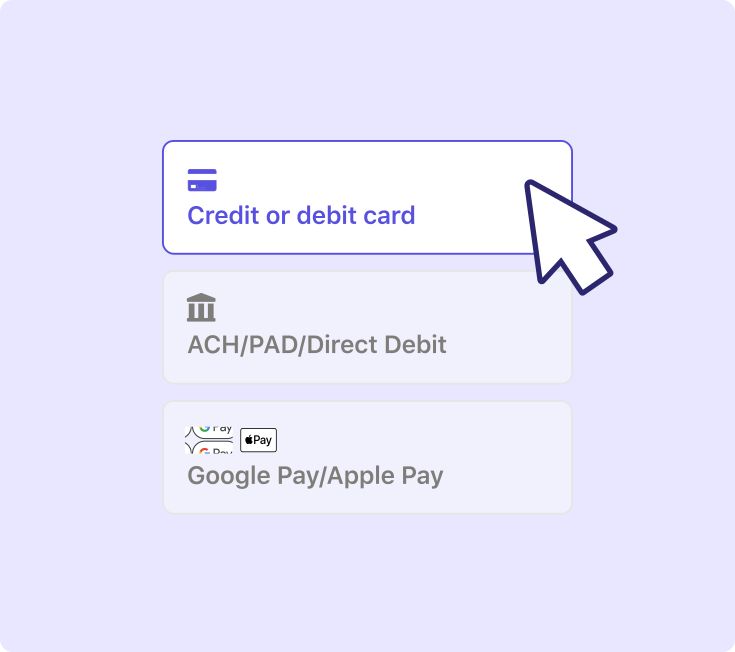
A surcharge adds a percentage to credit card payments, a convenience fee adds a flat charge for using an alternative payment channel, and ACH bypasses card networks entirely.
Surcharging, convenience fees, and ACH transfers all shift card costs off your business, but each comes with its own rules and paperwork. Here's how the three approaches differ before you pick one.
Criterion | Surcharge | Convenience fee | ACH transfer |
| How it's applied | Added when a customer pays by credit card | Flat charge for using an alternative payment channel | No added fee, bypasses card networks entirely |
| Fee structure | Percentage-based, capped at your actual card acceptance cost | Flat dollar amount, same across all card brands | Flat or no fee, set by the bank |
| Card types covered | Credit cards only; some states now ban debit surcharges | Applies regardless of card brand or type | Not applicable, no card network involved |
| Compliance steps required | 30-day notice to processor and card networks | Clear disclosure to customer before the transaction | No card network notification required |
Surcharging carries the heaviest compliance load of the three, since it requires card network notification and clear disclosure before a business can add it to an invoice.
A convenience fee works differently. A utility company that adds a flat charge when a customer pays a bill by card instead of by check illustrates the model: the fee applies to the payment channel, not as a percentage of the balance.
ACH transfers remove the card fee question altogether. Moving a client from card payments to bank transfer means the business never has to disclose a surcharge, register with a card network, or track a percentage rate, because the fee structure that applies to card payments doesn't apply to direct debit at all.
Compare your client payment options.
See how Ignition supports card and bank transfer collection.
Benchmark and set your surcharge rate
Set your surcharge rate at or below what card acceptance actually costs your business. That documented cost, not a round number that sounds fair, is the ceiling.
The average Visa and Mastercard credit rate covered earlier is a useful benchmark for checking your number. It is not a rate to apply blindly. If your blended cost is lower, applying the benchmark rate turns fee recovery into a markup.
Whatever figure you choose still has to clear the card network caps and state limits already covered. A rate that fits your cost structure but exceeds a network or state cap isn't usable, regardless of how well documented it is.
Colorado's attorney general settlement is a clear warning here. Domuso had to refund clients and adjust its practices. Cost-based pricing only protects you if it also respects the legal ceiling.
Pick one defensible percentage and apply it consistently across every client subject to the surcharge. A rate that shifts from client to client is much harder to justify if a client or regulator ever asks how you calculated it.
Weigh the tradeoffs before you commit
Passing card fees to clients protects your margin, but it can also create friction. Disclosing the surcharge early, applying it consistently, and building it into an automated workflow reduces the risk of damaging the relationship.
A surcharge makes your margin more predictable regardless of how a client chooses to pay. Many clients also expect convenient digital payment options, including cards and digital wallets, so offering that choice while recovering the cost can be a fair trade. The downside is dissatisfaction. A client who feels ambushed by an added fee is more likely to dispute it, delay payment, or question the relationship.
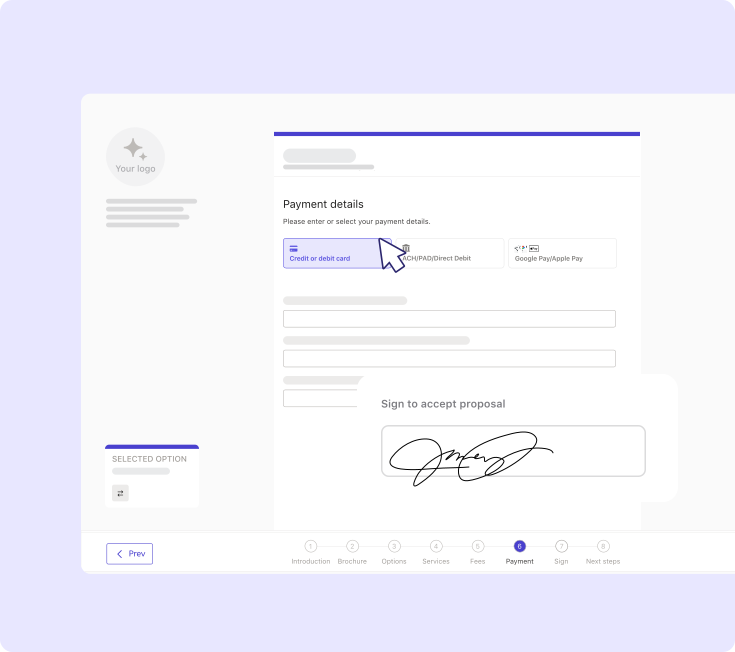
The difference often comes down to timing. A client who discovers a surcharge on an invoice after the fact may view it as a hidden cost. A client who sees the surcharge policy and payment options before authorizing payment is more likely to understand it as a standard term of the agreement.
The fee itself is only part of the issue. Adding it to an already manual, inconsistent billing process creates more room for confusion. For a broader look at how surcharging fits into your approach to card payments, see this guide to credit card payment strategies that protect cash flow and client satisfaction. Automating collections matters more than which fee model you choose.
Put surcharging inside automated collections
A surcharge only solves the cost of accepting a card. It does nothing about the larger drain on a business's time: manual collection. Addressing that problem requires upfront payment authorization and an automated workflow for existing invoices.
Ignition collects payment authorization at proposal signing, before work starts. The client's card or bank details are collected then, so the agreed payment method is already in place when billing begins. Staff doesn’t have to restart the payment conversation with every invoice.
Around 78% of Ignition customers report reduced late payments after using Ignition, showing what can change when the manual payment ask is removed from the client relationship.
AutoCollect extends the workflow to invoices already on the books. It imports outstanding invoices from Xero or QuickBooks Online into Ignition, bringing the accounts receivable backlog into one centralized collection process instead of leaving staff to track each balance manually.
Notify, disclose, and activate the surcharge
Implementing a surcharge follows three steps: notify, activate, and disclose. Complete them in that order so the required notifications and client-facing language are in place before the first surcharge is collected.
Notify your processor and card networks
Visa and Mastercard both require merchants to notify their acquirer and the applicable card network before surcharging, typically with 30 days' notice. That means your payment processor, acquiring bank, and each applicable card network need a heads-up before a surcharge goes live.
The notice period allows the networks to confirm that the surcharge complies with their rules. Activating a surcharge without completing this step could require corrective action.
The two networks handle notification differently. Confirm the current surcharge notification requirements directly with Visa and your acquirer, since Visa requires notice to both. Mastercard requires its own disclosure notification, so complete that process with the network and your acquirer before assuming you're cleared to surcharge Mastercard transactions.
Activate surcharging inside Ignition
Turning on surcharging in Ignition starts with a single setting in your payment configuration. Once your rate is set, the fee is applied automatically.
That fee gets calculated on top of the invoice or proposal total at the moment of payment, so the surcharge tracks with the amount owed rather than becoming a separate line item you manage by hand.
Clients see the surcharge before they commit to anything. When a client signs a proposal and enters card details, the added charge shows on screen before they authorize payment. The same applies to standalone invoices. The fee appears clearly before the client completes the transaction and is reflected on the payment record afterward, leaving less room for disputes over what was charged and why.
For the full setup process, including where to find the setting and how it interacts with different payment methods, Ignition's Learning Center walks through how to introduce card processing fees to your clients as surcharges.
Disclose the surcharge before you invoice
Clients must see the surcharge amount and rate before completing payment rather than discovering it buried in fine print afterward.
That disclosure has to show up everywhere a client might pay. The proposal, invoice, and payment screen all need the same clear wording: a stated rate, the dollar amount added, and a plain statement that it applies to credit card payments only.
The right moment for that notice depends on who is paying. A client already paying by card under an existing engagement needs advance notice of the policy change before their next invoice arrives, giving them time to switch to ACH if they prefer. A new client should see the surcharge upfront in the proposal and payment terms before signing, so there's no surprise once the engagement is underway.
Visa and Mastercard both publish guidance on acceptable disclosure signage and wording for merchants adding a surcharge.
Apply surcharges across retainers and invoices
Surcharge timing shifts with the billing model. Retainer renewals, project milestones, and out-of-scope work each need their own disclosure moment before the related payment obligation begins.
A business running monthly retainers should disclose the surcharge rate at renewal, not on a random invoice mid-cycle. A client who signed a retainer in January without seeing a card fee shouldn't discover one attached to their March invoice with no warning. The renewal date is the natural checkpoint because the client is already reviewing terms.
Project milestones need the same rate applied at every stage. If a business charges a surcharge on the deposit invoice but skips it on the final milestone, or changes the percentage partway through, the client may start questioning the billing setup.
Out-of-scope or change-order billing follows the same disclosed policy already in place for original scope work. If a client's retainer includes a surcharge and they're billed separately for work outside that scope, the surcharge applies the same way and at the same rate.
Fix collections, not just the fee
The real cost of that overdue invoice was never just the card processing fee. It was the 45 days of chasing that came before the client finally paid.
If a business decides to add a surcharge, automating the calculation and disclosure keeps the fee consistent without tracking it manually. If a business decides against surcharging, AutoCollect can bring outstanding invoices into a centralized collection workflow.
Either approach can reduce time spent manually chasing payments, leaving more time for billable work. See how Ignition's Payments & Collections supports faster, more predictable payments.
Get paid without the 45-day chase.
See how automated payment collection frees up time for billable work.
Frequently asked questions
-
Surcharging debit card transactions carries stricter restrictions than credit cards, and several states now ban it outright even where credit surcharges remain legal. Businesses should treat debit and credit surcharge rules as separate policies rather than assuming one blanket rate covers both card types. Confirming current debit-specific rules before billing protects a business from penalties tied to a fast-changing regulatory area.
-
Failing to meet card network notification or disclosure rules can expose a business to fines, forced refunds, or a processor freezing its merchant account. Visa and Mastercard actively monitor compliance and can require corrective action even after a single client complaint. Building disclosure into the billing workflow from day one, rather than treating it as an afterthought, is the safest path forward.
-
American Express and Discover generally follow surcharge guidelines similar to Visa and Mastercard, but each network sets its own notification timelines and rate caps. A business accepting multiple card brands needs to confirm requirements with each network separately rather than assuming one approval covers them all. Skipping this step is a common oversight that can create compliance gaps for businesses billing recurring retainers across several card types.
-
When a client refuses to pay a disclosed surcharge, offering an alternative payment method resolves most disputes quickly. ACH transfers or checks typically work well as fee-free options that avoid the surcharge question entirely. Building this flexibility into proposal or invoice terms keeps the payment conversation collaborative rather than confrontational.
-
Applying different surcharge rates to different clients or service lines is legal in most states. Each rate must still reflect the actual cost of accepting that specific payment method rather than an arbitrary markup. Agencies billing both retainers and project work may apply consistent logic within each billing category instead of one flat rate across the entire client roster.