The service provider's guide to invoice payment terms



 Copied to clipboard.
Most service businesses have a collection timing problem, not a pricing one. Work gets delivered, an invoice goes out with Net 30 terms, and the waiting begins. The invoice lands in an approval queue, sits unopened, or gets buried in someone’s inbox. In many cases, the client isn't intentionally delaying payment.
Invoice payment terms define when clients are expected to pay, but choosing the right ones requires more than defaulting to Net 30 because it’s the industry standard. The terms that work for a monthly bookkeeping retainer differ from those that protect a six-month consulting project or an hourly engagement billed in arrears.
This guide breaks down the most common invoice payment terms, shows how each one affects cash flow, and helps you match terms to the way you actually bill, whether that's retainers, project milestones, or hourly work.
Key takeaways
- Invoice payment terms define when and how clients pay, from Net 30 and due on receipt to milestone-based schedules and early payment discounts.
- The right invoice payment terms depend on your engagement model because retainers, projects, and hourly work carry different cash flow risks.
- Longer invoice payment terms can increase days sales outstanding (DSO) and delay cash collection, even when clients intend to pay on time.
- Clear payment terms on both proposals and invoices can reduce disputes by spelling out due dates, payment methods, discounts, and late fee policies.
- For many service businesses, upfront payment authorization at proposal acceptance may work better than invoice payment terms alone because it removes the post-delivery payment chase.
What invoice payment terms are
Payment terms are credit rules. They define when payment is due, how a client can pay, and what happens if they don't pay on time.
The moment a service business delivers work before collecting cash, it has extended trade credit, even if the invoice says "due on receipt."
That distinction matters for three reasons: Payment term selection affects receivables risk, signals client fit, and shapes cash flow. Terms alone rarely fix late payments.
These terms should appear consistently across proposals, engagement letters, and invoices. Mismatches between those documents are a common source of payment disputes.
A bookkeeping firm completes monthly work, sends an invoice labeled "due on receipt," and still waits. Why? Because the client has to open the invoice and choose to pay. The credit risk exists regardless of what the terms say.
The most common invoice payment terms explained
Most invoice payment terms describe timing rather than certainty. Net 30 sets the due date. It can't make the client act.
Before choosing a term, ask three questions:
- When is work delivered?
- Who carries the cash flow risk?
- Who must take the next action to trigger payment?
A monthly advisory retainer works well with upfront billing: the client pays before work begins, and no one chases payment. A website redesign project billed Net 30 after delivery puts the entire risk on you. An hourly consulting engagement invoiced weekly falls somewhere between.
Any post-delivery term creates an accounts receivable gap that the billing structure, not the due date, should close.
Net 7, net 15, net 30, net 60, and net 90
Net 30 is the most common payment term. Smaller bookkeeping firms serving SMB clients often protect cash flow better with Net 7 or Net 15, keeping revenue moving without long gaps between work delivered and payment received.
Longer terms carry a different tradeoff. A consultant landing a large enterprise client may have no choice but to accept Net 60 because procurement policies often dictate it. That extends DSO and ties up working capital you may need to cover payroll or overhead.
Use shorter terms whenever clients will accept them. Reserve Net 60 or Net 90 only when a client's size or contract value genuinely justifies the wait.
Due on receipt
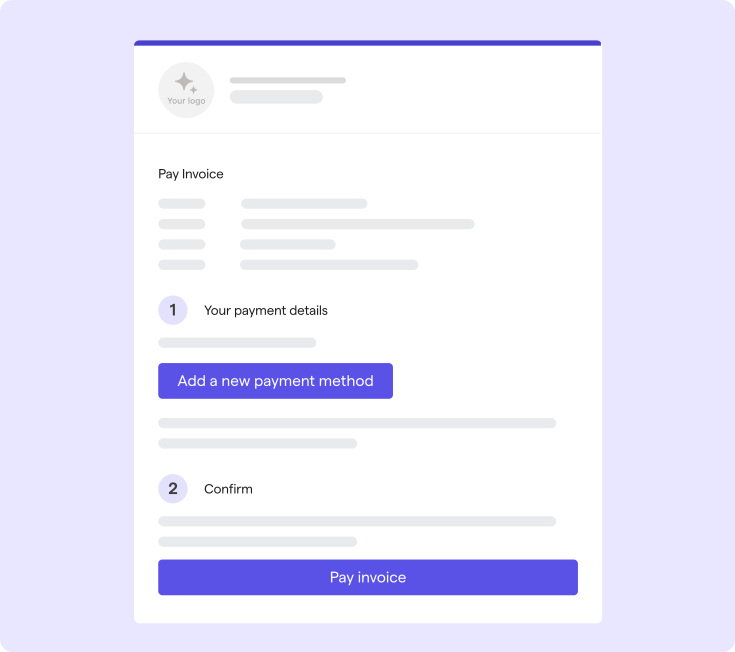
Due on receipt shortens the payment window on paper. The client still has to open the invoice and act, and nothing compels that decision.
It works well for straightforward, one-off engagements, such as a single consulting session or a small creative deliverable invoiced after completion.
Clients with internal approval steps or AP queues won't move faster just because your invoice says "due on receipt." Capturing payment details upfront is the only way to eliminate manual follow-up.
Cash in advance and payment in advance
Collecting payment before work begins is the lowest-risk billing structure available. It eliminates invoice chasing and post-delivery exposure by confirming payment before the project starts.
Advance payment is standard policy tied to project kickoff, not a trust signal. A tax professional might collect a deposit before a large cleanup engagement. A marketing agency might require 50% upfront before campaign setup begins. Both are reasonable, professional, and easy to explain.
Full prepayment works best for high-value or labor-intensive projects. A partial deposit still reduces risk while giving clients flexibility, and a clear scope makes either request feel routine.
Milestone-based and installment payment structures
For longer projects, tying invoices to specific deliverables reduces the risk of a single large payment falling through. The trigger has to be objective. Vague milestones create the same disputes as vague scope.
Take a consulting project structured as 30% at kickoff, 40% at strategy delivery, and 30% at final implementation. Each trigger is easy to verify and hard to dispute.
Define these triggers before work starts. Ignition's milestone billing capabilities let you automate charges at each stage, so payment follows delivery without manual follow-up.
Early payment discounts: The 2/10 Net 30 model
The 2/10 Net 30 model gives clients a 2% discount for paying within 10 days. Otherwise, the full amount is due in 30 days. It can accelerate cash collection, but the math deserves scrutiny before you adopt it.
On a $5,000 invoice, a 2% discount costs $100. For a small advisory business, that's real margin. If profit margins are already thin, trading $100 to avoid a collections follow-up may not pencil out.
Compare the discount cost against your average time spent chasing that invoice. If collections friction regularly exceeds that dollar amount, the tradeoff may be worth it.
How to choose the right payment terms for your firm
Match your terms to your service model instead of following habit. Map each service line to its billing type, then choose the least risky collection method clients will accept.
- Recurring services (monthly bookkeeping): Automated recurring billing
- Project work (implementation): Milestone billing tied to deliverables
- Hourly advisory: Upfront retainer or short net cycles
The right term is the one that keeps receivables within your comfort zone without creating friction that slows client acceptance.
Retainer-based engagements
Retainer work promises predictable revenue, but billing that still depends on a monthly invoice and a 30-day wait erodes that predictability.
A bookkeeping firm invoicing after month-end, then waiting another 30 days to collect, is effectively financing its clients' operations. Charging on the first of the month for work that's already underway is a straightforward fix.
Two changes make the difference:
- Capture card or ACH authorization at proposal acceptance
- Set the recurring charge date in Ignition's Smart Billing to trigger before monthly work begins
With Smart Billing, the charge runs automatically without manual invoicing or payment chasing. Authorization happens once, at the proposal stage, so every subsequent month collects without extra effort.
Project-based engagements
Waiting until final delivery to collect payment means financing the entire project yourself, including every revision round and approval delay along the way.
Instead, spread payment across three defined points:
- Upfront deposit (30-50%) due at contract signing
- Mid-project invoice tied to a specific deliverable, such as draft approval
- Final payment due at handoff
For a consulting or agency engagement, this structure protects your labor from scope creep and slow approvers. Each milestone also creates a natural checkpoint if payment stalls.
Hourly billing engagements
Hourly billing is the hardest arrangement to protect against late payments. When you send an invoice after work is complete, clients must approve the value they've already received, and disputes can follow.
Monthly arrears billing on Net 30 terms compounds the problem. By the time an invoice arrives, the work feels distant, increasing the likelihood of payment delays or write-offs.
Consider one of these alternatives:
- Weekly invoicing
- Prepaid blocks of hours billed at the start of the engagement
- Card-on-file authorization captured at proposal acceptance
A marketing agency that moves from month-end Net 30 to weekly billing can reduce dispute risk immediately. Inconsistent billing cycles and weak enforcement are common contributors to cash flow problems for agencies.
How payment terms affect your cash flow
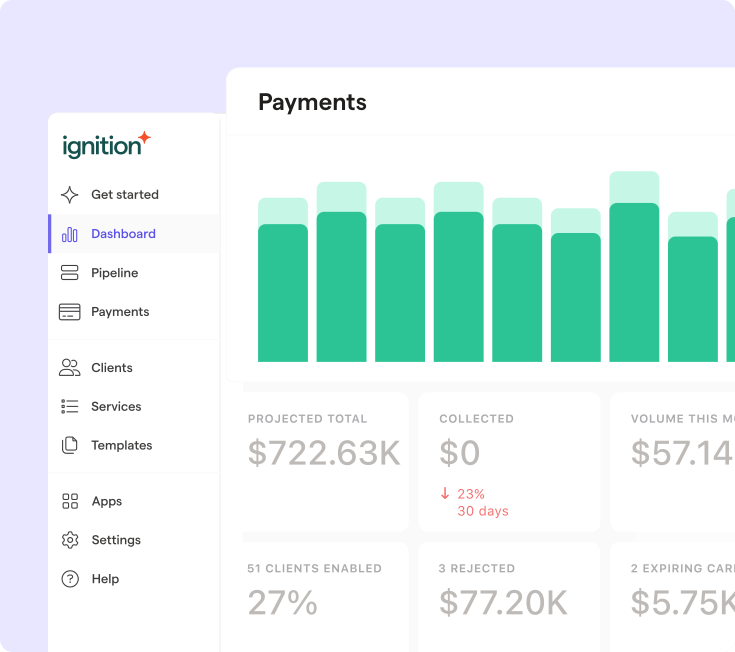
Payment terms determine when revenue reaches your bank account, not just when an invoice is due. DSO measures the gap between billing and collection, and longer terms increase that gap across your client base.
The math is straightforward. If you have 15 clients each paying $3,000 per month on Net 30 terms, you're carrying roughly $45,000 in outstanding receivables at any given time — money you’ve earned but haven’t collected. Across a year, those delays can quietly strain your business during periods of economic uncertainty.
To estimate your own exposure, multiply your average monthly client fee by your total client count. That's roughly what sits in receivables under Net 30 terms.
Now compare that with capturing payment authorization upfront and billing automatically on schedule. The same 15 clients generate little to no receivables because payment is processed on the agreed billing date.
How to write payment terms on an invoice
Clear invoice wording reduces confusion, but it only works when it matches the agreement your client already signed. Mismatched terms are a common source of payment disputes.
Use these examples:
- Deposit: "50% deposit due upon receipt. Remaining balance due at project completion. Accepted via [ACH / credit card]."
- Late fee: "A [X]% monthly late fee applies to balances unpaid after [N] days, where permitted by law."
- Net 15: "Payment due within 15 days of invoice date. Accepted via [ACH / credit card]."
- Milestone billing: "[X]% due at [milestone, e.g., project kickoff]. Remaining balance of [Y]% due at [milestone, e.g., final delivery]. Accepted via [ACH / credit card]."
Every invoice should include the due date, accepted payment methods, any early payment discount, and late fee policy. Confirm late fee requirements in your state before including them.
Match your invoice wording to your proposal or engagement letter. For broader formatting guidance, see how to create invoices for professional services.
Move beyond term optimization by authorizing payment upfront
Better invoice terms can reduce friction, but they don’t eliminate the collection process. The structural fix happens earlier: at proposal acceptance, before work begins.
With Ignition, clients enter payment details and agree to a billing schedule when they sign a proposal. Billing then runs automatically based on that schedule.
A bookkeeping business running monthly engagements on Net 30 invoices after delivery can instead capture ACH or card details during proposal acceptance and automatically bill on the agreed date, whether that's the first of the month or at a project milestone.
The shift changes the payment process before collection becomes a problem. It helps protect revenue while reducing the administrative work that grows with every client relationship.
Stop chasing invoices and start collecting payments automatically
Capture payment details upfront, automate billing, and create a more predictable cash flow with Ignition.
FAQs
-
Common invoice payment terms include Net 7, Net 15, Net 30, Net 60, due on receipt, cash in advance, and milestone billing. Your invoice should also state the due date, accepted payment methods, any early payment discount, and any late fee policy. For project work, installment terms tied to clear deliverables may help reduce disputes and keep revenue more predictable.
-
Net 30 means the full invoice amount is due 30 days after the invoice date. Due on receipt asks the client to pay as soon as the invoice arrives, with no standard waiting period. In practice, both still rely on the client to initiate payment. Shorter terms help set expectations but can't compel the client to act.
-
For recurring services, shorter terms usually support healthier cash flow than Net 30 or Net 60. Many firms get better results by capturing payment authorization when the proposal is signed, rather than invoicing after delivery. That approach may help eliminate chasing, reduce risk, and make recurring revenue more predictable.
-
List the exact due date, payment terms, accepted methods, and any late fee or discount in plain language. Vague wording like "payable upon completion" invites disputes and slows collection. If the engagement has milestones, match each invoice to a named deliverable so timing and scope stay clear.
-
Clear terms help, but enforcing them usually requires automated reminders, consistent follow-up, and a written late fee policy. A stronger fix is collecting payment details before work starts, then billing automatically through Ignition at proposal acceptance. That shifts payment from a reactive invoice chase to a planned workflow, which may help prevent late payments altogether.