What should an accounting service agreement include?



 Copied to clipboard.
A client emails asking for "one quick add-on" to their bookkeeping package, and there's nothing in writing to tell you whether that's billable, included, or grounds for a scope conversation you don't have time for during tax season.
A service agreement template is a reusable framework that accounting and professional services firms customize to define each client's scope, fees, responsibilities, timelines, renewal terms, and legal protections before work begins. It gives every engagement a consistent starting point while still allowing you to spell out client-specific details clearly.
Firm owners managing dozens or hundreds of client relationships need more than a Word doc that looks professional. They need a framework built for how accounting engagements run: recurring services, seasonal renewals, and constant risk of scope creep.
Key clauses protect revenue, distinguish a service agreement from an engagement letter, and show where a static template stops being enough once client volume grows.
Key takeaways
- A strong service agreement template defines scope, payment terms, responsibilities, timelines, renewal terms, and risk protections before client work begins.
- Accounting firms often need engagement letters, not just generic service agreements, to support compliance and clear client expectations.
- Scope creep protection starts with a template that explains change orders, out-of-scope work, and how extra services will be billed.
- Static service agreement templates can break down as firms grow, especially during bulk sending, annual renewals, and tax season onboarding.
- Connected agreements can help close the gap between signature and payment by linking client acceptance to billing, payment collection, and accounting tools.
What is a service agreement, and why does it matter for accounting firms?
A service agreement gives an accounting firm an operational record of scope, fees, responsibilities, and payment expectations that everyone can refer back to instead of piecing things together from email.
Before, staff sign a Word document, save it to a folder, and forget it until a dispute arises. After, approved scope and fees flow directly into billing, the same way a strong business proposal sets up the engagement.
How a service agreement differs from an engagement letter
An engagement letter is an accounting-specific agreement shaped by professional obligations, while a service agreement is a broader contract that can cover many types of client services. CPA, tax, and accounting firms often need the engagement-letter format because professional bodies and risk policies attach specific expectations to that document.
Check whether your professional body, service type, or firm risk policy requires an engagement letter before defaulting to a generic template. Ignition's Contracts & Engagement Letters capability embeds those accounting-specific terms directly into the client lifecycle.
For clause-level guidance, get tips on personalizing engagement letters for advisory services.
The core components every accounting service agreement should include
Every accounting service agreement needs clear operational terms for the work and practical protections for the risks surrounding it, including scope, payment terms, responsibilities, timelines, termination, liability, and confidentiality.
No template replaces legal advice or fits every firm's circumstances.
Before tax season, pull up your current Word template and treat the sections below as an itemized audit, checking each one against what's actually written down.
Scope of services
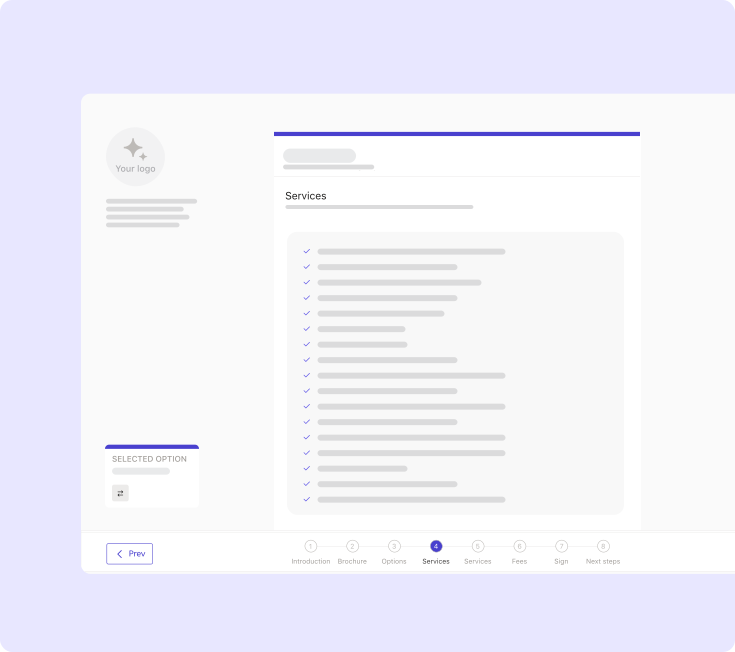
what's excluded, what assumptions apply, and what the client must provide. For each service, list the deliverable, name what's excluded, and assign the client input required to complete it. A professional service description template helps structure this consistently across clients.
Monthly bookkeeping means reconciled accounts by a set date, assuming the client uploads bank statements on time. Tax preparation covers the return itself, not prior-year cleanup. Payroll support processes submitted hours; it doesn't include correcting misclassified employees. Advisory meetings are capped at a defined number per quarter.
Every service prone to expanding, cleanup work especially, needs an explicit boundary stated in writing before the engagement starts.
Payment terms and billing schedule
Payment terms should tell the client exactly how much they'll be charged, when billing happens, when payment is due, and which payment methods are accepted. Clear terms also spell out any late-fee policy, so both parties know what happens if a payment slips.
The billing schedule has to match how the work actually gets delivered. Recurring bookkeeping needs a monthly or fixed-cadence trigger, upfront retainers need a deposit trigger, and project work needs milestone or completion triggers.
Before finalizing the agreement, check every fee against a billing event. If a service lacks a due date, cadence, and payment method, that's unbilled revenue waiting to become a collections problem.
Timelines, deliverables, and responsibilities
Timelines and responsibility clauses work only when each deliverable is tied to a deadline, a response expectation, and the party accountable for it. A vague "returns filed on time" promise doesn't hold up once a deadline slips.
A client who submits tax records two weeks late pushes the filing date back under the agreement's own responsibility terms, which place responsibility for the delay on the client rather than the firm. Documenting that dependency protects the firm from blame for a delay it didn't cause.
Assign an owner and a due date to every client input that can stall the work: bank statements, payroll records, prior-year returns, and signed authorizations. List each one next to the person responsible and the date it's needed, so nothing critical stays buried in an email thread.
Termination and renewal terms
Termination and renewal terms should state how long the engagement lasts, how either party can end it, and what must happen before it renews or closes. That means setting an effective date, a fixed or ongoing term, and a clear process for continuing or ending the work.
Spell out the notice period required from either side, the method for written notice (email, certified mail, or client portal message), how outstanding fees get settled, and when renewal terms kick in.
CPAI guidance shows documented termination practices support risk management for CPA firms. Add the next renewal date and required notice window to every recurring agreement now, before it becomes a scramble.
Liability, confidentiality, and indemnification
Liability, confidentiality, and indemnification clauses protect sensitive information and define which party bears specific legal or financial risk if something goes wrong. You're holding confidential financial records, tax filings, and personal data for clients who may be based in different states or countries, each with its own privacy and disclosure rules.
Confidentiality provisions restrict how that data can be shared or used. Liability clauses cap the firm's financial exposure if a dispute arises. Indemnification assigns responsibility for losses tied to specific failures, such as inaccurate client-provided data.
None of this works as generic wording copied from a template. Have legal counsel review confidentiality, liability, indemnification, and governing-law provisions before use, since enforceability shifts by jurisdiction and risk tolerance.
Building scope creep protection into your template
A service agreement protects revenue from scope creep only when precise exclusions pair with a written process for approving and billing extra work. Informal requests handled over email or a quick call rarely get invoiced, and that unbilled time erodes margins across recurring accounting and agency accounts.
Before drafting the exclusion language, list the three out-of-scope requests your firm hears most often. That list becomes the foundation for the change-order clause.
Change order clauses that trigger immediate billing
A change-order clause turns extra work into revenue by defining what qualifies as out-of-scope work, who signs off on it, how it's priced, and when billing happens. Without that structure in place before the firm lifts a finger, "extra work" just becomes an unpaid favor.
The sequence matters. Identify the out-of-scope request as soon as it surfaces, document it as a revised service or amendment, and get client approval where the clause requires it.
Once approved, issue the charge immediately instead of parking it in an email thread. Ignition agreement amendments let a firm formally update scope and pricing, while Instant Bill charges the client the moment work is approved. For a closer look at building this into a contract, see this agency contract guide.
Fix scope creep and late payments
Learn more about building change-order clauses that trigger billing the moment work is approved.
Why static templates break down as your client list grows
Static templates become unreliable once client volume outpaces version control, tracking, and renewal visibility. A firm managing more than 100 clients can't rely on individual Word documents, scattered email threads, and disconnected e-signature tools to track who signed what and when terms expire.
Check your own process right now. Can you name the current terms, signature status, and renewal date for every client without opening multiple files?
Bulk sending and renewal management during tax season
Bulk sending and renewal visibility keep tax-season agreements from turning into a client-by-client scramble for signatures. Without a shared view of renewal dates, staff end up chasing individual documents through inboxes while filing deadlines approach.
The fix starts with standardized terms. Lock in the scope and conditions that hold across the client base, then layer in client-specific pricing and service details so nothing needs rebuilding from scratch for each account.
Before the seasonal sending cycle begins, segment clients by three factors: renewal date, service type, and any pricing change. From there, apply the standard terms, personalize the fee, send agreements in bulk, and track acceptance status in one place, so no client starts tax work under an expired agreement.
From signed agreement to paid invoice: closing the billing gap
A signed agreement has limited operational value when staff still create invoices, request payment details, and start billing by hand. Signature alone doesn't generate an invoice, capture payment authorization, or trigger recurring billing if those systems sit apart from the contract.
Walk through your own process: After a client signs, who creates the invoice, who requests card or bank details, and who schedules the first charge? Each answer is a manual handoff standing between acceptance and cash flow.
Connecting agreements to Xero, QuickBooks, and payment collection
Integrations close the billing gap by carrying accepted scope and fees straight into accounting records, invoices, and payment collection workflows, so nothing sits idle waiting on manual entry. Once a client accepts an agreement, the terms already exist in the system, ready to bill against.
Ignition connects to both Xero and QuickBooks, syncing client and billing details the moment an agreement is accepted. That acceptance can trigger invoice creation, apply the agreed billing schedule, and initiate payment collection without staff re-entering fees or chasing a signed PDF for reference.
Test this on one client file. Trace a single accepted agreement through invoice creation, payment authorization, and reconciliation in Xero or QuickBooks. Every step that still requires copying figures, manually generating an invoice, or emailing a client for card details is a handoff worth removing.
Structuring agreements for retainer, project, and time-and-materials billing
Retainer, project, and time-and-materials agreements need different scope boundaries, payment triggers, and approval rules because each billing model creates revenue in a different way. A retainer earns revenue every month regardless of ticket volume. A project earns revenue at defined checkpoints. Time-and-materials earns revenue based on hours logged, so the agreement has to protect against disputes over what got billed.
Retainers need recurring service definitions, cadence, included capacity, and renewal terms. A monthly SEO retainer should state the deliverables included each month, the hours or tasks that count as capacity, and the renewal or auto-continuation date.
Project agreements need deliverables, milestones, deposits, and completion triggers. A website build should tie each payment to a milestone, such as design approval or launch, not to a calendar date.
Time-and-materials agreements need rates, time-tracking methods, expense treatment, and approval thresholds. Ad hoc strategy hours should specify the hourly rate, how time gets logged, whether expenses are billed at cost, and the dollar amount that triggers client approval before work continues.
Choose the billing model before drafting scope and change-control language, since scope boundaries only work when they match how the engagement actually gets billed. This guide to structuring an agency contract breaks down clause-level detail for each model.
Turn your service agreement template into an automated client lifecycle with Ignition
A static agreement falls apart after signing because it doesn't catch scope drift, trigger a new invoice, or protect the relationship when expectations shift.
Pull up the last agreement that led to a billing dispute or an awkward renewal conversation, and ask where the breakdown happened. Almost always, the breakdown happens after signing, when scope changed or payment stalled with no system tracking it.
That's the gap Ignition closes. Proposals turn signed approval into an immediate billing trigger, and Contracts & Engagement Letters handles amendments without forcing a full re-sign, so scope changes stay documented instead of forgotten.
Faster onboarding, tighter scope control, and fewer billing gaps happen when the agreement stops being a static file and starts running the client relationship. Replace the template sitting in a folder somewhere with a system built for what comes after the signature.
Your agreement shouldn't stop at signing
Ignition turns signed approval into billing triggers and handles amendments without a full re-sign.
Frequently asked questions
-
A single service agreement template can standardize core terms, but each client agreement still needs client-specific scope, pricing, and responsibilities. Firms working across states or regulated services may need attorney-reviewed clauses for local requirements, professional standards, and risk tolerance. Use the template as a controlled starting point, not a one-size-fits-all contract.
-
A connected digital template is generally the most scalable format because it can keep the agreement, acceptance, billing setup, and renewal workflow together. Word and Google Docs are useful for drafting but can create version-control and approval issues as client volume grows, while locked PDFs still leave signatures, billing, and renewals in separate processes.
-
An accounting firm or agency should review its service agreement template at least annually and whenever its pricing, services, professional requirements, or risk policies change. Tax season, new advisory packages, and recurring retainer changes are common review triggers. Maintaining one approved template library helps partners avoid outdated clauses and inconsistent client commitments.
-
Someone with authority to bind the business entity should sign its service agreement. Multi-entity groups, spouses, or related parties may require separate signatures to confirm each party's scope and responsibility. Capturing the correct signer before work starts reduces disputes over who approved the services and who is responsible for payment.
-
The firm should obtain a signed agreement before starting work because proceeding without one increases the risk of unclear scope, delayed payment, and disputed approvals. A stronger process is to send the agreement immediately, collect acceptance online, and obtain any required payment details before kickoff.