Multiple signatures in proposals: How billing starts



 Copied to clipboard.
One co-owner signs the proposal. The other hasn't opened the email yet. Billing stays frozen until both names appear on the page.
That's what multiple signatures in proposals look like in practice. Co-owners, joint filers, or a client's approval committee each need to sign before the engagement is authorized. If you're still routing contracts through Word docs, email, or a generic e-signature tool, that wait creates a real operational stall.
Work can't start. Invoices can't go out. Nobody on the client side knows who still needs to sign, and nobody on the firm side knows when to follow up.
This article explains when billing starts relative to that final required signature, and why that timing sets a proposal-to-payment platform apart from a standalone signing tool.
Key Takeaways
- Billing on a multi-signature proposal typically starts only after the final required signer completes, not the first.
- Standalone e-signature tools stop at a signed document, so payment collection still becomes a separate step for the firm.
- Sequential signing order matters more for agency client approval chains than for two-owner accounting engagements.
- Grouping co-owners as parallel signers works best when every party carries equal financial responsibility for the fee.
- A multi-party signature only holds up legally when each signer shows clear intent and consent to sign electronically.
Why multiple signatures trigger billing automatically
Let’s start with the platform aspect, since we’ll be showing you how these different multi-signature workflows work inside Ignition specifically.
Ignition connects a fully accepted multi-signature proposal directly to billing and payment authorization, so your firm never treats payment setup as a separate task. Once every required signer completes Ignition Proposals, that acceptance data flows straight into Payments & Collections and starts the client's billing cycle.
Most e-signature tools stop at a signed document. Even the ones that have added broader workflow automation still hand you a completed contract and leave billing setup for someone to configure by hand, often in a different app entirely.
That’s where onboarding stalls. The real test is whether acceptance moves straight into billing without a manual handoff.
How the last signature starts automatic billing
Billing and payment authorization start only after the final required signer completes the proposal.
The sequence runs in order. One signer opens the proposal and signs first. The proposal then sits in a pending state, fully visible but not yet actionable, while any other required signer still needs to complete their part. Only when the last required signature comes through does the proposal move to fully accepted.
Ignition then activates payment authorization and billing. There's no separate billing step to trigger after the agreement closes. No one has to check who's signed, chase a second signature, or flip billing on once the proposal is complete.
Notifications and audit trails for signers
Each required signer gets an automated notification the moment a proposal needs their approval, and a timestamped audit trail tracks exactly who has signed, who's still outstanding, and when each approval landed.
With sequential signing, the next signer only gets access once the person before them completes their part. Parallel signing works differently. Every signer receives the proposal and a notification at the same time, and each signature registers separately on the record.
Before this kind of tracking, an approval chain scattered across email threads leaves you guessing who actually agreed to the engagement. After it, you can point to a single proposal record showing every signer's status and timestamp if a client disputes what was approved.
The same tracking applies to additional document signatures inside a proposal.
Build a friction-free client journey
Watch the webinar to see how firms map every step from proposal to signed and paid.
Types of multi-signer access in Ignition
The use cases above cover when multiple signatures matter for a proposal. What follows covers which plan gives you access, and how many signatories you can add per engagement.
Joint tax returns need filer's signature
A proposal covering a joint tax return isn't complete until both spouses sign, no matter how detailed the scope or how clear the fee.
Ignition lets you send one shared proposal instead of splitting the engagement into two separate documents for each filer. Both names sit on the same scope, the same fee, and the same signature block.
Say one spouse signed last week, and your firm is still waiting on the other. Nothing moves until that second signature lands. That protects your firm from starting a Form 1040 engagement with only half the household committed, and it keeps billing from kicking off on an engagement that isn't fully authorized yet.
Multi-owner firms protect decisions with sign-off
Requiring every owner or partner to sign a proposal creates one documented record that all decision-makers approved the same scope and fee.
It's a common scenario: A client asks for extra work mid-engagement, one partner agrees on a call, and work starts. Months later, another partner reviews the invoice and disputes the fee, arguing the firm never agreed to that scope.
With only one signature on file, there's no record showing the full partnership signed off. It's just one person's word against another's, and an engagement letter that doesn't cover the change.
A proposal built for multiple signatories addresses that. Every partner's approval sits on one record tied to billing.
Agency retainers often need committee approval
An agency retainer proposal frequently needs sign-off from more than one client-side stakeholder before work and billing can begin. That's the reality of agency-client structures, where budget authority rarely sits with a single person.
The approval path usually runs in a set order. A client's marketing director reviews scope first, confirming the deliverables match what the team actually needs. Only after that scope approval does the finance lead step in to sign off on the fee. Getting this sequence right at the proposal stage matters as much as the pricing itself.
Until both approvals land, the retainer stays pending. Billing can't activate on a half-approved agreement, and if your agency manages multiple client accounts, tracking who's approved what across every retainer becomes a real operational drag without a clear system.

Which Ignition plans support multiple signatories?
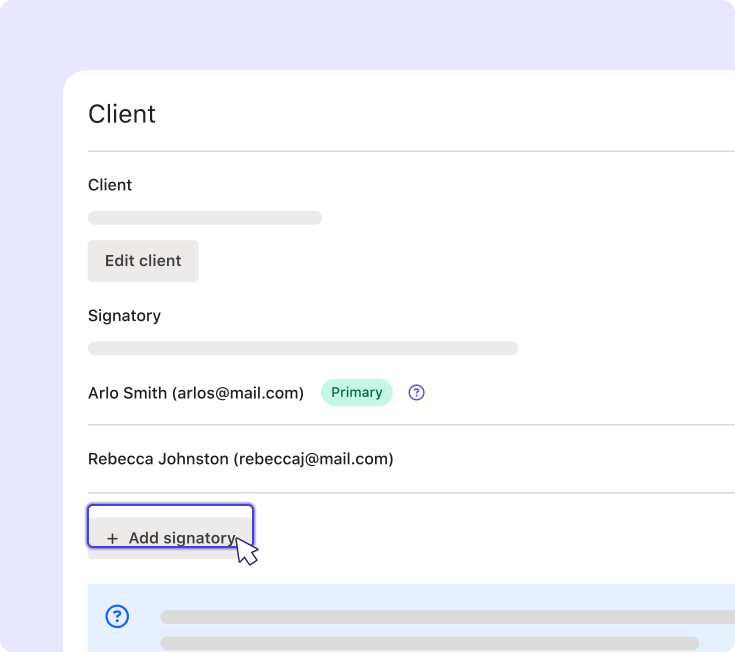
With multiple signatures, two people can electronically sign your engagement terms and proposal on the Professional plan, or you can have up to ten signatories on the Scale plan.
All you need to do next time you create a proposal in Ignition is add all signatories once you’ve selected your client. You’ll need to have more than one contact saved against your client record to use multiple signatures, but you can easily add more contacts from this step.
Group signers vs. sign separately
The right signer setup depends on shared responsibility, required approval order, and documented consent. Two co-owners with equal say can sign as a group. An agency retainer routed through a marketing director, then a finance lead, needs signers handled in sequence.
The next few points cover parallel signing for co-owners, sequential chains for approval hierarchies, and consent records for every signer, including cases like separate engagements per entity.
Group co-owners for joint financial decisions
Co-owners fit a parallel signing flow when each person carries equal responsibility for the engagement and its fee. Neither owner is more accountable than the other, so the proposal should treat their signatures the same way.
Two co-owners running a small accounting or bookkeeping firm sign one engagement letter together for a new advisory client. Both names carry equal weight on the fee, and both need to approve the scope before work starts.
Grouping them as parallel signers reflects that reality. There's no approval hierarchy to justify, since neither owner outranks the other on this decision. Each signature gets collected on equal footing, and billing starts once both are in.
Separate signers when approval must be sequential
Sequential signing fits approval chains where one stakeholder must approve the proposal before the next person receives it. Set this up when a client's internal hierarchy needs review in a fixed order.
That ordered handoff mirrors how the client actually makes decisions internally. It also means billing doesn't start on a proposal that skipped a required layer of approval.
Document each signer's consent for every proposal
Every signer, regardless of grouping or order, must show clear intent to sign and consent to do business electronically for the signature to hold up.
This isn't an Ignition-specific rule. It comes from the baseline set by the Electronic Signatures in Global and National Commerce Act (ESIGN Act) and the Uniform Electronic Transactions Act (UETA), which require intent, consent, and a signature tied directly to the record it authorizes.
That signature must also attach directly to the proposal and stay on record as evidence the transaction happened.
The same baseline applies whether the proposal covers a tax return, a bookkeeping engagement, or an agency retainer. Legal requirements for electronic consent don't shift by industry, and your proposal record needs to hold up the same way in any of them.
From last signature to first invoice
Joint filers, multi-owner firms, and agency committees all land in the same place. The engagement sits pending until every required signature clears, and the only question worth asking is whether that final signature is wired to billing or just filed away in a folder.
A three-partner firm waiting on the last approval before an invoice can go out is in the same predicament as a bookkeeping practice chasing one spouse's signature on a joint return. In both cases, someone has to notice the contract is done and kick off the billing. That handoff is where cash flow stalls.
This week, look at the last engagement that sat "fully signed" for days before anyone billed it. That delay is the cost of disconnected tools, and it's fixable.
Connect signing to billing
Remove the manual step between final signature and first invoice.
Frequently asked questions
-
Most proposal platforms let a firm add each required signer by name, role, and email address before the proposal goes out. From there, you choose whether signers complete the document in parallel or in a set sequence, depending on how the engagement needs to be approved. Ignition's Proposals product builds this signer setup into the same workflow that ties directly to billing once every signature is complete.
-
In most cases, yes, a firm can update or replace a listed signer if the wrong person was assigned before every signature is collected. This flexibility matters for agency retainer approvals, where a client's internal approver sometimes changes mid-process. Making this change before the final signature completes keeps the proposal, and the billing trigger tied to it, accurate.
-
A multi-signature proposal stays in a pending state until every required signer has completed their part, so a stalled signer holds up the entire engagement. No billing or payment authorization begins while any signature is outstanding, which protects both the firm and the client from a half-authorized agreement. Firms can typically resend reminders or adjust the signer list to move a stuck proposal forward.
-
Not necessarily, since the added time usually comes down to signing order rather than the number of signers itself. Parallel signing, where every required party is notified at the same time, can move nearly as fast as a single-signer proposal. Sequential signing, often needed for hierarchical approvals like an agency's internal sign-off chain, naturally adds more turnaround time between each step.
-
Multiple signatory support is generally built into proposal functionality rather than sold as a separate add-on charge. Exact signer limits can vary by plan tier, so firms evaluating this capability should confirm current tier details when setting up their account. For most accounting, bookkeeping, and agency use cases, the value comes from tying every signature to automatic billing, not from an extra line-item fee.