The case for pairing brochures with digital proposals



 Copied to clipboard.
Turning a promising prospect into a signed, paying client is harder than it should be when the path forces you to build proposals in Word, manually attach contracts to emails, and invoice separately. Marketing brochures (branded print or digital assets that explain your services, value, and credibility) help smooth that path before the formal paperwork even starts.
Professional marketing brochures support the sales conversation without defining scope, pricing, or signature requirements, which means a prospect arrives at your proposal already oriented instead of starting from zero.
Pair a strong brochure with a connected digital proposal and you have a practical system for turning polished marketing into action. With the right message, format, and workflow, you can move prospects toward a signed engagement with fewer manual steps and less back-and-forth.
Key takeaways
- A professional marketing brochure builds trust by clearly explaining a business's services before a prospect reviews scope or price.
- Polished brochures can reduce buyer uncertainty before contract discussions begin.
- A truly professional brochure combines a clear value proposition, credible proof points, an adaptable format, and one defined call to action.
- Building an effective brochure starts with defining the audience and objective before drafting content or design.
- Embedding a brochure directly into a digital proposal can help businesses move from impressing a prospect to getting paid faster.
What is a professional marketing brochure?
Professional marketing brochures build trust by presenting a business's services and commercial identity clearly, before or alongside a formal proposal. Consistent branding, service descriptions, and messaging help prospects understand who you serve and what you offer, so they arrive at the proposal conversation already oriented.
They’re not:
- Flyers to promote specific offers
- Sales decks to support live presentations
- Service catalogs listing available options
Professional brochures sit in a different lane, giving prospects a focused, branded overview that connects your commercial identity to their needs, without the formality of a signed agreement.
Use it during initial follow-up, include it with the proposal, or embed it inside one. When promotional materials are disconnected, prospects have to piece together your value on their own. A consistent brochure does that work for them.
Why professional brochures win more business
A well-made brochure reduces buyer uncertainty before prospects evaluate scope, price, and contract terms. When someone understands your expertise and approach upfront, they come into the proposal conversation with fewer reservations and a clearer sense of whether you're the right fit.
Think about what a prospect actually needs in those early stages: reassurance about your expertise before price enters the picture.
Consistent positioning, relevant proof, and plain language across your brochure, website, and client communications build that confidence over time. A prospect who already trusts your expertise is easier to convert than one still figuring out who you are.
A brochure is one tactic within a broader marketing strategy, not the whole sales process. Pair it with practical approaches for marketing advisory services, then guide interested prospects into a formal proposal workflow.
What makes a marketing brochure professional
A marketing brochure becomes professional when it delivers four things: a clear value proposition, credible proof, an adaptable format, and one obvious next step. Leave any one of them out and the whole thing loses impact.
Value proposition and service overview
Your value proposition should tell prospects what your business does, which problem it solves, and how each service package helps. Lead with the service and the client need it addresses rather than the internal label your team uses.
Connect each service to a concrete outcome. "Monthly bookkeeping" doesn't tell a prospect much. "Keeps your financial records current so you have clearer information for business decisions" does.
The same principle applies to package names: Replace vague labels like "Premium" or "Growth" with plain descriptions prospects can actually parse. Clear labels like "Monthly bookkeeping and reporting" identify the service, its purpose, and the expected outcome without making anyone guess.
Proof points and testimonials
Specific, sourced proof points, testimonials, and case studies transform a brochure from marketing material into a credibility tool. A prospect comparing options wants concrete client evidence, not broad claims about expertise.
When selecting proof, prioritize outcomes that relate directly to the services you're promoting. With client permission, name the client, the service delivered, and the result achieved. Walk through the challenge, your approach, and the outcome.
Every claim needs to be accurate, current, and appropriate for a professional services audience. Keep a source record for each outcome, confirm client approval, and protect confidential details. If you can't substantiate or present a statement responsibly, cut it.
Print, digital, or proposal-embedded format
Format follows context. Print works for in-person interactions. Digital and proposal-embedded versions create a more direct path to the next step.
A polished handout at a conference gives prospects something to take away. A downloadable PDF after a remote consultation is easy to share by email. And when a prospect is ready to decide, presenting brochure collateral inside a digital proposal keeps your brand, service details, packages, pricing, and next step together in one place.
No switching between documents, no lost momentum.
A clear call to action
Every professional brochure needs one explicit call to action. One. Not several.
Match the ask to where the prospect is in the buying process:
- Early-stage prospect: "Book a consultation."
- Scope and pricing ready: "Review the proposal."
- Ready to decide: Link the brochure to Ignition Proposals and direct them to select a service package, accept their preferred option, and sign the engagement letter.
The goal is to make the next step obvious, not to give them options to weigh.
How to build a professional brochure
Building a professional brochure follows three steps in order: define the audience and objective, structure the content, then apply the design. Jumping ahead to design before finalizing the content is the most common reason brochures end up vague or generic.
Define your audience and objective

Start by naming one specific client segment and one action you want that segment to take. The more precise, the better: new bookkeeping clients, growing agency owners, existing tax clients who need advisory support.
From there, work through three questions:
- What's the main problem this segment is trying to solve?
- What proof will build their confidence in your approach?
- What service information do they need to evaluate your business?
This audience-focused planning keeps the brochure relevant rather than generic. Once you have the answers, choose one intended action based on that audience. A new prospect may need to book a consultation; an existing client may need to review an expanded service package. Write that action at the top of your content plan and cut anything that doesn't help the reader take it.
Draft your content hierarchy
A strong brochure hierarchy leads with the value proposition, follows with service detail and proof, adds relevant pricing context, and closes with the call to action. That order guides prospects through your message without making them hunt for what matters.
Each stage answers a specific buying question:
- Headline: Why does your business matter to this prospect?
- Business overview: Who do you serve, what do you do, and why is your approach relevant?
- Service overview: What do you offer, and what does each service solve?
- Proof: Approved testimonials, sourced outcomes, credentials, or brief case study details.
- Pricing context: How are packages structured? (This isn't the place for the full proposal.)
- Call to action: One clear next step.
Draft each section in plain language before touching the design. Cut repeated claims and internal terminology prospects won't recognize. If a detail doesn't answer a buying question or build confidence, it doesn't earn its place.
Design your brochure with the right tools
The best design tool is the one your team can use consistently to produce a polished, readable, on-brand asset. Choose one that fits your skills and makes future updates straightforward.
Start with a brochure template and set clear controls for layout, typography, color, and imagery. Save an approved master template so every team member works from the same design instead of rebuilding from scratch.
Three tools worth considering:
- Canva: Accessible, low-cost, and well-stocked with templates. A practical starting point for most service-based businesses.
- Adobe Express: Customizable templates for consistent marketing collateral with more brand control.
- Figma: Suits teams that need precise layout control and shared design workflows.
Before distributing, prepare the file for its intended format. For print: confirm page size, margins, image resolution, color settings, and bleed with your printer, and request a proof before approving the full run. For digital: export a PDF with working links and a manageable file size, then review it on desktop and mobile. Keep one approved version in a shared location with clear file names, and archive older versions so your team doesn't accidentally send outdated information.
From brochure to signed, paid engagement
A professional brochure has the most commercial value when it connects directly to the proposal, signature, billing, and payment workflow. An isolated PDF can build interest, but it can't close the deal.
Ignition Proposals lets you reuse brochure collateral within a formal proposal, where clients review services, accept terms, and authorize payment. Once the client signs, billing starts automatically, creating a faster path from a polished brochure to a signed, paid engagement.
Embed existing collateral into digital proposals
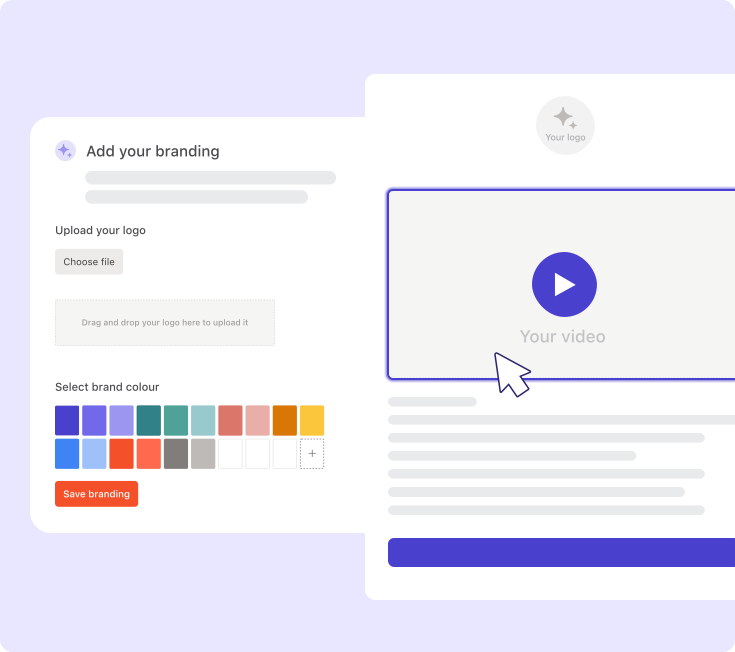
Reusing brochure collateral inside a digital proposal preserves your marketing work while keeping service selection and signature inside the formal buying workflow. Your brochure supports the proposal rather than becoming another document to send and track separately.
In Ignition Proposals, place relevant brochure copy, visuals, and proof points alongside your service packages. Clients review the value, select services, and provide an e-signature through one proposal experience. That cuts duplicate document preparation and keeps the path to engagement clear.
Looking for more detailed guidance on proposal messaging, scope, pricing, and structure? Check out this guide on how to write a marketing proposal.
Automate billing the moment clients sign
Billing should start automatically when a client signs, not after a separate invoicing step. That removes the manual handoff between agreement, invoice creation, and payment collection and gets revenue moving sooner.
Set the billing schedule, due dates, payment methods, and late-payment conditions before sending the proposal. Clear payment terms give clients unambiguous billing expectations, and payment authorization at signing avoids another request after the fact. Ignition Proposals connects acceptance directly to billing and payment collection, giving your business a shorter path from "yes" to getting paid.
Turn brochures into signed, paying clients
A professional brochure only wins business when it's paired with a workflow that turns interest into a signed, paid engagement. Ignition Proposals connects service packages, e-signatures, billing, and payment authorization in one workflow, giving you a direct path from presenting your services to formalizing terms with a marketing agency contract template.
Strong presentation builds trust. A connected proposal-to-payment process turns that trust into revenue. Make the next client engagement easier to approve, sign, and pay with Ignition.
Turn interest into signed, paying clients.
Ignition Proposals connects service packages, e-signatures, billing, and payment authorization in one workflow.
Frequently asked questions
-
Printed brochures still hold value for in-person meetings, conferences, and walk-in client interactions where a tangible, branded piece reinforces credibility. Many businesses now pair a printed brochure with a digital or proposal-embedded version, since prospects often research online before ever meeting in person. Your choice of print, digital, or both should depend on how your audience actually engages with the business.
-
A professional marketing brochure should be as short as possible while still covering the value proposition, service overview, and proof points a prospect needs. Keep the document concise so readers reach the call to action without unnecessary detail. Scannable sections with clear headings matter more than total length.
-
Review a marketing brochure at least once a year, or sooner if service packages, pricing, or credentials change. Outdated pricing or old testimonials can undermine the credibility a brochure is meant to build. Businesses that update proposal templates or engagement letters regularly should apply the same discipline to brochure content.
-
A brochure can't replace a formal client proposal, since it's a marketing asset, not a scoped agreement with pricing, terms, and a signature. A proposal defines what the client is buying, what it costs, and how billing will work once accepted. Ignition Proposals lets businesses embed existing brochure content directly into that formal proposal, so marketing and agreement live in one document.
-
Businesses generally see stronger results from tailoring brochure content to specific services or client segments rather than using one generic version for everyone. A bookkeeping client and an advisory client care about different proof points, pricing context, and outcomes. Segmented brochures also embed more cleanly into a proposal built for that specific service package, keeping the buying experience relevant from first read to signature.