

How marketing agencies can reduce late payments before work even starts


 Copied to clipboard.
Payroll runs Friday. Three retainer clients haven't paid their invoices from three weeks ago, and the follow-up emails you've already sent are sitting unanswered in their inbox.
This scenario repeats every month at agencies of all sizes, and it’s rarely solved by writing a better reminder. Reducing late payments at your marketing agency comes down to designing payment terms, authorization, billing, and escalation into one workflow before client work ever begins.
When authorization is collected at proposal signing and charges are tied directly to the accepted agreement, the manual chase largely disappears.
Key takeaways
- Late payments are usually a workflow gap you can close before work starts rather than a client problem.
- Collecting payment authorization at proposal signing removes the need to ask for money later.
- Billing directly from signed agreements ensures what you scoped is exactly what gets charged.
- Billing scope creep immediately protects revenue that generic profitability advice often overlooks.
- A documented escalation ladder keeps firm boundaries while still supporting clients facing real hardship.
Why marketing agencies struggle with late payments
Marketing agencies struggle with late payments when vague terms, delayed invoicing, approval bottlenecks, scope creep, and mixed billing models create manual gaps between completed work and payment. Every one of those gaps needs someone on the team to chase, clarify, or re-explain a charge, and each handoff adds days to the timeline.
Vague payment terms leave clients unsure exactly what they owe and when. Invoicing after delivery means the agency is always billing in the past instead of getting authorization up front. Client approval bottlenecks stall invoices in someone's inbox. Undocumented scope creep adds unbilled hours that surface weeks later as a disputed charge. Mixed billing models force separate manual calculations for retainers, projects, and variable fees, multiplying the chances of an error that delays payment.
This is a workflow design problem rather than a reminder-writing problem. An agency managing 30 or more recurring clients can't fix five structural gaps by sending friendlier follow-up emails, especially when payroll and contractor invoices come due on fixed dates regardless of when client payments land.
The scale of the issue is well documented: 97% of agencies deal with late payments.
Tired of chasing clients for money you've already earned?
See how agencies close and collect faster with one connected workflow.
A 7-step plan to reduce late payments
Agencies get the most benefit by implementing late-payment controls in order, moving from prevention through billing and backlog recovery to escalation.
Each step builds on the one before it. Clear agreements set up accurate billing, accurate billing supports backlog recovery, and backlog recovery makes escalation consistent instead of reactive.
1. Set payment terms clients can't misread
There are seven specific elements that belong in every agency proposal, spelled out in plain language a client can act on without asking questions:
- Fee and billing schedule
- Due date
- Payment authorization
- Late-payment process
- Scope boundaries
- Pause conditions
These items go together in one client proposal or signed agreement, so make sure you’re not scattering them across an email thread and a contract. Keeping them in a single document gives the client one source of truth before any work starts, so there's no confusion later about what was agreed, when payment is due, or what happens if it isn't paid on time.
Legal requirements around payment terms and service pauses vary by state, so this checklist is a starting point. Consult legal advice tailored to your agency's location.
2. Collect payment authorization when the proposal is signed

Collecting payment authorization at proposal signing replaces the need to ask for payment details every time a charge comes due with a single client approval. The client enters payment information as part of accepting the proposal, once, rather than reviewing an email request each billing cycle.
Authorization at signing doesn't trigger an immediate charge. It sets up future transactions to run automatically according to the billing schedule already spelled out in the agreement, whether that's a monthly retainer or a milestone-based project fee.
Those transactions are processed securely through Stripe, so the client's payment details are stored and charged on schedule without anyone on the agency side manually keying in numbers or chasing a card update.
Before: Work gets delivered, then someone emails the client asking for payment details or a card number, and the invoice sits open until they respond.
After: The client authorizes payment once at signing, and each scheduled charge processes automatically. That single change removes the recurring payment ask from the relationship entirely.
3. Let the signed agreement control what gets billed
The exact scope, price, and schedule the client accepted become the charges the agency issues when the signed agreement controls billing. There's no separate step where someone re-keys the retainer amount into an invoicing tool or guesses at the billing date.
Manual re-entry is where errors creep in. A fee gets mistyped, a start date shifts, or an invoice goes out for a service that was scoped differently than what the client actually signed. Each of those mistakes generates a client email, a delay in payment, and time spent tracing the discrepancy back to the original agreement.
Linking accepted scope directly to invoicing removes that gap entirely. The agreement becomes the single source of truth for what gets charged and when.
Use Billing Hub to review every upcoming invoice tied to signed agreements before it goes out. Checking Billing Hub regularly means catching a pricing or scheduling issue while there's still time to fix it, not after the client has already flagged it.
4. Bill scope creep the moment it happens
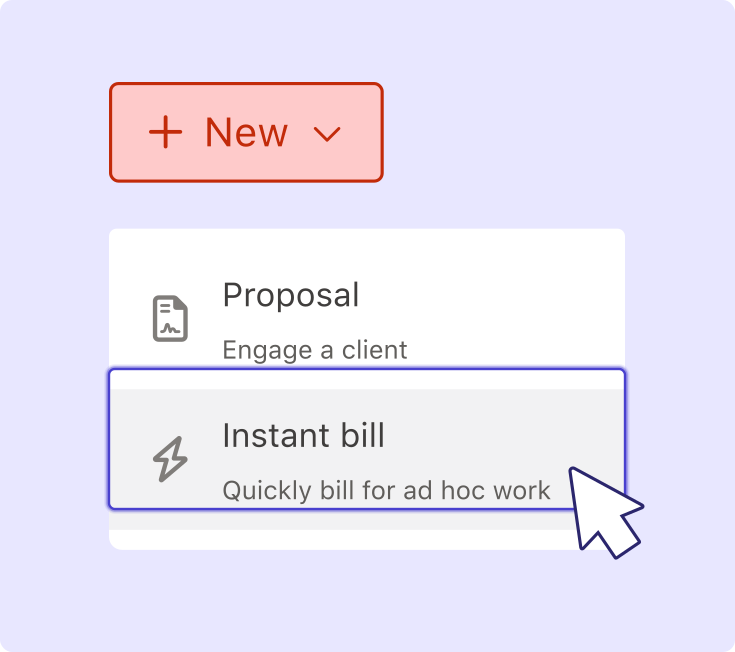
Agencies prevent scope creep from becoming delayed or lost revenue by getting written acknowledgment before extra work begins and billing the approved change immediately. Waiting until the next invoice cycle to add a scope change buries it in a larger balance, which gives the client more room to question or delay the whole payment.
The sequence matters. When a client requests something outside the signed agreement, walk through these steps in order:
- Flag that the request falls outside the current signed scope.
- Document the added work and the fee attached to it.
- Get written acknowledgment from the client before starting the extra work.
- Issue the charge immediately rather than at the end of the month.
For one-off requests, use Instant Bill to charge for ad hoc work as soon as it's approved. For smaller, ongoing scope changes that don't warrant a full re-sign, an agreement amendment lets you update the terms and notify the client without renegotiating the entire contract.
5. Run recurring and variable billing from one system
Retainers, project fees, and variable charges can all run from one workflow instead of calculating and updating each billing model separately, giving agencies a single system for every billing type. Retainers renew on schedule, project fees bill once at a fixed price, and variable charges shift with headcount or usage, but none of that requires a separate spreadsheet or a different tool.
Start by mapping each active service to its correct billing model inside the client agreement. A retainer stays tied to its renewal date, a project fee stays tied to its milestone, and a variable charge stays tied to the metric that drives it, so nothing depends on someone remembering to recalculate it each month.
Use Smart Billing to automate supported headcount- or usage-based charges as those numbers change, and use AutoPricing to apply fee increases across multiple clients at once instead of editing each account individually.
6. Clear the invoice backlog sitting in Xero or QuickBooks Online
Agencies can recover an existing invoice backlog by triaging overdue balances before moving eligible items into an automated collection workflow. Start by pulling every outstanding invoice out of Xero or QuickBooks Online so the full scope of overdue revenue is visible in one place, instead of scattered across client folders and email threads.
From there, prioritize by three factors: age, value, and dispute risk. Oldest and largest balances deserve attention first, since they carry the greatest cash flow impact, while invoices tied to an active client dispute should be set aside and resolved directly before any collection action begins.
Once disputed or ineligible items get separated out, the remaining clean balances are ready to move. AutoCollect imports eligible outstanding QuickBooks Online or Xero invoices directly into Ignition's automated collection workflow, so your agency stops manually re-chasing balances that are already sitting in the accounting system.
Resulting payments process securely through Stripe, giving the agency one consistent collection path for both new billing and recovered backlog.
7. Build a documented escalation ladder for overdue accounts
A documented escalation ladder gives every overdue account the same staged response, while still leaving room for clients facing genuine hardship. Instead of deciding case by case when to follow up or how firmly to word a message, the agency runs a fixed sequence every time.
The ladder moves through six stages in order:
- A pre-due reminder before the invoice is due
- An overdue notice once it lapses
- Direct contact by phone or email
- A payment-plan review
- A service-pause review
- A final demand
Each stage needs a standard operating procedure with four fields: who owns it, how many days after the previous stage it triggers, the approved message template, and what gets logged on the account file. That documentation matters when a client disputes a charge or when the account reaches the final-demand stage and needs a clear paper trail.
Marie Greene of Connected Accounting used to chase overdue balances with repeated phone calls, a process that strained client relationships even when the money eventually came in. Switching to automatic monthly withdrawals, paired with a firm policy of not starting new work after a failed payment, removed that chasing entirely.
For clients facing genuine hardship, the payment-plan review stage is where a written payment plan, a short extension, or a limited discount can keep the relationship intact without abandoning the ladder altogether. It can feel awkward handling difficult client payment discussions, but a structured process makes it easier.
Watch client concentration as closely as late payments
One overdue client can threaten payroll or contractor payments if that client represents a large share of agency revenue, even if every other account pays on time. A retainer client covering 45% of monthly revenue that misses a payment date creates a cash gap no amount of on-time smaller invoices can offset fast enough.
A common concentration guideline, frequently used in agency financial planning and cash flow risk management, caps any single client at 40% of total revenue. Treat it as a planning heuristic rather than a guaranteed safe limit. A client below that threshold can still create serious strain depending on payroll timing, contractor commitments, and how much cash buffer exists that month.
Calculate exposure directly: Divide each client's trailing 12-month revenue by total agency revenue. Run this calculation monthly or quarterly, not once a year, since client mix shifts as contracts start, scale, or end.
Flag any client crossing 30-40% of trailing 12-month revenue for closer payment-term review, faster invoicing, or a larger cash reserve tied specifically to that account. Tracking concentration is a way to know exactly where a single delay could hit the business hardest, rather than a sign of distrust.
How Ignition helps agencies reduce late payments
Ignition helps agencies reduce late payments by connecting upfront payment authorization, billing based on signed scope, and AutoCollect for eligible outstanding invoices into one workflow instead of three separate manual tasks.
Right now, your team probably requests payment details after work is delivered, re-enters signed scope into a separate invoicing tool, and chases an outstanding Xero or QuickBooks Online backlog through a different process entirely. Each gap is a place a payment can stall.
Collecting payment authorization at proposal signing closes the first gap, turning that single approval into automatic future charges instead of repeated email requests for a card or bank account.
Agreement-linked billing closes the second, since invoices pull straight from what the client already signed off on rather than a number someone re-keys separately.
AutoCollect closes the third, folding eligible backlog invoices from Xero or QuickBooks Online into that same automated workflow instead of a separate follow-up process.
- One authorization at signing replaces repeated requests
- One billing source: the signed agreement
- One collection workflow for new and eligible backlog invoices
Turn this plan into a connected billing and collection system
A connected billing and collection system works by closing the gaps where invoices used to sit ignored for weeks, rather than catching every late payer before they slip. That client who signed off on an expanded scope mid-project but never got billed for it until the next invoice cycle? That's the exact moment a connected system pays for itself, charging the card on file the day the work happens instead of hoping someone remembers three weeks later.
Before the next proposal goes out, stop separating the agreement from the payment method. Build authorization into the signing step itself, so acceptance and billing are the same action instead of two separate follow-ups.
Ignition's Contracts and Payments & Collections tools are built for exactly this handoff, linking e-signature to stored payment details so the first invoice never depends on a client remembering to log in and pay. That's the difference between a backlog that grows quietly and one that resolves itself.
Stop separating your agreements from your payments
Connect proposals, billing, and collections in Ignition and start getting paid automatically.
FAQs
-
Payment authorization at proposal signing lets a client approve future charges without requiring an immediate charge. Charges then follow automatically on the schedule already agreed to, processed securely through Stripe. Around 78% of Ignition customers report reduced late payments after adopting this authorization-at-signing approach, based on Ignition's own customer data.
-
An escalation process differs from a reminder by being a documented sequence applied consistently to overdue accounts, following the same stages described above, rather than one message decided fresh each time. Assigning an owner and timing to each stage stops the agency from deciding collections case by case.
-
AutoCollect handles this by importing eligible outstanding invoices from QuickBooks Online or Xero into Ignition's automated collection workflow. After triaging balances as described above, move the eligible ones into AutoCollect while handling disputed or ineligible items separately. This gives your agency a structured way to recover backlog balances without maintaining another manual chasing process.
-
A large client increases your agency's cash flow exposure because one overdue payment can affect payroll or contractor commitments. The 40% concentration figure is a planning signal rather than a hard cutoff, so a client below it can still warrant attention depending on timing and cash buffer. Calculate each client's share of total revenue and review concentration regularly alongside overdue balances.
-
Offer a written payment plan or a limited extension with a specific new due date when a reliable client faces genuine hardship. Use discounts sparingly so the arrangement doesn't unnecessarily reduce collection value. Document the exception in the client account and in your agency's collections procedure so the next action remains clear.


