How Ignition helps firms profit from CAS packages



 Copied to clipboard.
Client advisory services (CAS) can create steady recurring revenue, but accounting firms often lose profitability before the engagement even begins. They underprice packages, leave scope too open-ended, or wait too long to collect payment, making it harder to scale advisory work profitability.
Firms with stronger margins usually run a tighter process behind the scenes using best practices for CAS. They standardize packages, set pricing guardrails, define scope upfront, and build payment collection into the engagement from day one. Rather than treating every client like a custom project, they create systems that make revenue more predictable.
Below, we’ll explore the operational pieces that help make CAS more profitable: packaging services, protecting pricing, managing scope creep, collecting payments upfront, and repricing annually. We’ll also look at how Ignition helps turn those processes into repeatable workflows that support long-term recurring revenue.
Key takeaways
- Profitable client advisory services start with outcome-based packages that define deliverables, boundaries, and tiered options clients can compare with confidence.
- Your pricing floor should come from direct delivery costs and target gross margin, not guesswork, so every advisory package has room to profit.
- Clear engagement letters and automated proposals can help lock scope before work begins, which reduces confusion, limits unpaid extras, and protects margins.
- Collecting payment details upfront and automating recurring billing may help firms turn CAS into predictable revenue instead of delayed invoices and manual follow-up.
- Annual renewals and price updates create a repeatable way to repackage services, reflect growing client needs, and build compounding advisory revenue over time.
Why CAS pricing breaks down before delivery even starts
CAS margin problems are often built into the engagement before delivery begins. Firms sell advisory work around broad outcomes or leave too much room for scope to expand. Some use billing terms that slow down payment collection later on.
The work itself may be valuable, but the engagement structure makes profitability harder to maintain as the client relationship grows.
That’s where a lot of CAS pricing advice tends to fall short. Pricing strategy matters, but firms also need operating guardrails that hold up during real client relationships, especially when priorities shift, timelines change, or clients add additional services mid-engagement.
CAS can create stronger margins than compliance work. But those gains depend on tighter controls around scope, billing, and delivery. Without these engagement processes in place, firms have a harder time protecting advisory margins as clients’ needs expand.
Build packages around outcomes
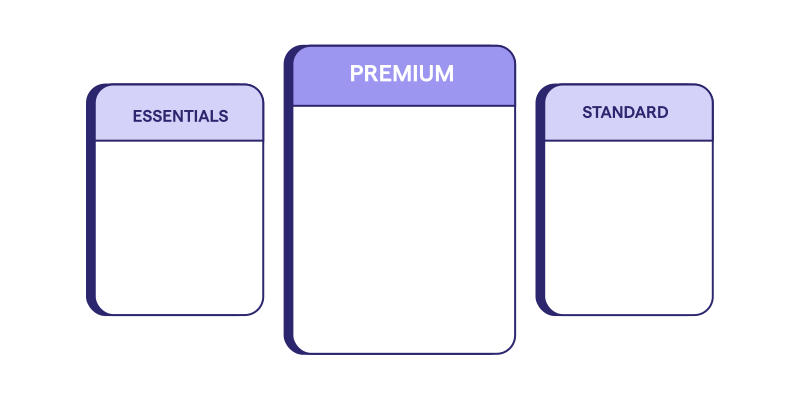
Clients buy outcomes rather than advisory time or access: clearer decisions, better visibility into performance, or momentum on specific priorities.
Bronze, Silver, and Gold packages often miss the mark. They describe effort, not value. Strong CAS packages focus on what the client is trying to accomplish at a certain stage, rather than a list of services.
Each package should map to a clear problem set and cadence. For example, one might focus on monthly reporting and visibility, while another focuses on regular decision support and planning cycles. A higher tier might include ongoing advisory tied to execution and accountability.
When tiered pricing packages are structured around outcomes, they’re easier for clients to understand and for firms to deliver without eroding margins.
Define three tiers with fixed deliverables and clear scope boundaries
Three-tier CAS structures work best when each level is based on complexity (e.g., reporting, planning, strategic advisory), not vague bundles of services.
Each tier should clearly state what’s included, how often the firm engages, and how quickly clients can expect responses. That removes ambiguity before the engagement starts and reduces friction later when priorities change.
Spell out what sits outside the scope, too. That’s what reduces scope creep and protects your bottom line when “quick questions” start turning into ongoing work.
A simple example:
- Tier 1: Reporting CAS
- Monthly financial reporting and review meeting
- Standard KPI dashboard updates
- Email response within set business hours
- Out of scope: tax advisory, ad hoc analysis, cash flow forecasting deep dives
- Tier 2: Planning CAS
- Monthly reporting plus forward-looking cash flow and budgeting session
- Quarterly planning review
- Limited between-meeting support
- Out of scope: real-time advisory, project-based consulting, transaction support
- Tier 3: Strategic Advisory
- Bi-weekly advisory sessions
- Ongoing planning and decision support
- Priority response window
- Out of scope: full-time operational management, implementation services, compliance work outside agreed base
Calculate your minimum viable price before setting any package fee
Before thinking about value-based pricing or market comparisons, start with a pricing floor. This is the minimum price point that keeps the engagement profitable after you account for delivery time, tools, and overhead.
The purpose of the floor is simple: it protects cash flow first, before premium positioning or negotiation comes into play. Once it’s set, you can make more confident pricing decisions on where to hold firm, where to flex, and when to adjust for the client.
Say a CAS engagement requires 12 hours per month at a blended cost rate of $80 per hour. That’s $960 in direct labor.
Add $150 for client tools and systems, bringing the total monthly cost to $1,110.
With a 60% gross margin target, the minimum viable price comes out to roughly $2,775 per month.
Direct cost plus target gross margin equals your pricing floor
Build your pricing floor using this simple calculation:
Direct cost ÷ (1 - target gross margin) = Minimum viable price
From the above example: $1,110 ÷ (1 - 0.60) = $2,775
It gives you a clear baseline for pricing a CAS package to stay profitable. It’s a floor, not the final fee, since it only covers the cost of delivering the work at a minimum margin. It doesn’t account for pricing strategy, client value, complexity, or engagements that take more time than originally scoped.
When estimating capacity, be realistic about where advisory time goes. Time that isn’t tightly allocated tends to get absorbed by ad hoc questions, extra check-ins, and informal reviews, eating into package margins.
Lock scope at the proposal stage to protect your margins
CAS profitability comes down to scope control. When proposals are vague, every client request can become unbilled work that slowly chips away at margins over the life of the engagement.
That’s why scope needs to be locked in early and reinforced at every step. It should live in the proposal, carry through contract terms, and show up clearly in billing workflows. If it only exists in emails or kickoff notes, it can easily expand in practice.
The piece many firms miss is defining change control upfront. Setting clear triggers for when work moves outside the agreed scope turns extra advisory work into a pricing decision, rather than something absorbed into delivery.
Tools like Ignition help standardize this at the proposal stage with templates and packaged services, making scope clear from day one while keeping engagements easy to manage as client needs evolve.
What belongs in an advisory engagement letter
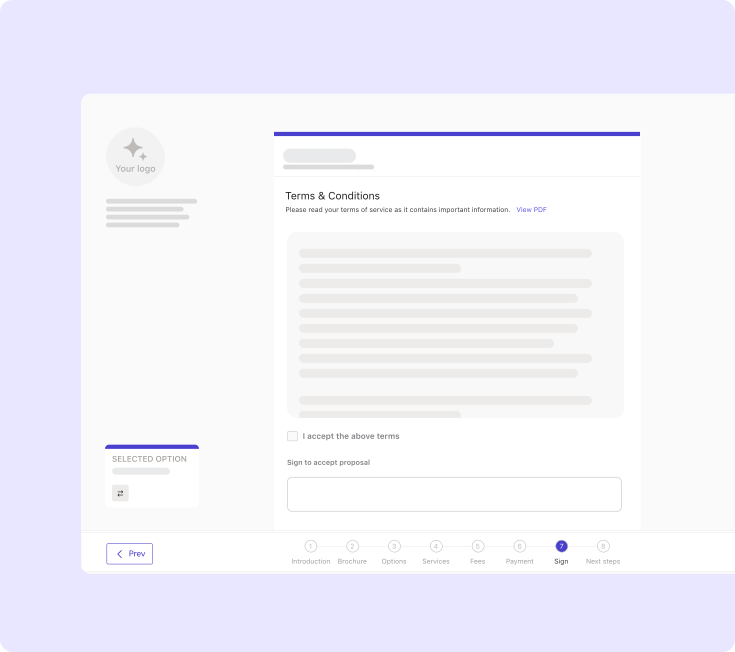
A strong advisory engagement letter sets expectations before the work starts. It lets clients know how the engagement will run, what’s included, and where the boundaries are from the beginning. At minimum, an agreement defines:
- Deliverables and reporting expectations
- Meeting cadence and response times
- Client responsibilities and required inputs
- Turnaround assumptions for reviews and approvals
- Communication limits and support boundaries
- Pricing terms and payment structure
- Renewal timing and repricing expectations
- What triggers a scope change or additional fee (e.g., added entities, new forecasting work, increased meeting frequency, extra reporting requests)
Getting these details in writing upfront saves you from having to negotiate delivery in the middle of the engagement.
For recurring CAS retainers, include billing language that lines up with how services are delivered over time. Clear terms make recurring revenue easier to manage internally and create a more consistent experience month after month.
How automated proposals with e-signature eliminate scope ambiguity
One clear, accepted digital proposal gives the firm and the client a single place for scope, pricing, terms, deliverables, and approvals. That makes it much easier to manage expectations once the engagement is underway.
It also cuts down on side agreements and informal approvals that tend to happen across email threads and in disconnected documents. Instead, you have a clear record of what the client approved and what the engagement includes.
That clarity carries through the rest of the workflow. Billing, onboarding, and future scope changes become easier to handle, since the engagement starts with aligned terms and documented approvals.
Tools like Ignition can help you streamline this process with automated proposals and built-in e-signatures, so your firm can standardize engagements from the beginning.
Collect payment before work begins

Upfront payment functions as a profitability rule, not a collections preference. In CAS, margins often come under pressure when work begins before you’ve collected payment, even if the engagement was approved.
The gap usually appears right after a client accepts a proposal. The engagement moves forward, but billing sits in a separate process, creating friction at the moment you’re moving toward delivery.
Connecting proposals, billing, and payment collection in one workflow closes that gap. A revenue operations solution like Ignition aligns approval and payment in a single process, eliminating the disconnected steps between acceptance and invoicing.
When you collect payment details upfront and store them on file, you reduce late-payment follow-ups and gain a clearer view of secured revenue before work begins.
Renew and reprice annually to build compounding advisory revenue
CAS pricing rarely stays aligned with the work over a 12-month period. Client needs change, delivery efforts shift, and the cost of delivering advisory services moves even when the package structure stays the same.
When firms set pricing once, they tend to repeat the same number at renewal and rework the logic each year. But that turns pricing into a reset exercise instead of something that builds over time.
Annual repricing updates prices based on how the engagement performed, not just what was originally agreed on. That approach turns renewal strategy into a practical way to keep fees aligned with the work clients now need, without having to start from scratch every renewal cycle.
Connect pricing strategy to delivered profitability with Ignition
Ignition helps you both make and operationalize pricing decisions for CAS. Pricing floors set during package design carry through into proposals, and automated payments ensure work doesn’t start without collection in place. Change orders maintain scope control, keeping small asks from turning into unpaid work.
Meanwhile, AutoPricing and AI Price Insights support strategic, revenue-building package structures from the start, while Business Insights shows how pricing and renewal decisions perform once engagements are live. And Smart Billing integrations keep invoicing aligned with actual delivery activity.
When pricing, scope, billing, and delivery stay connected, your firm can protect the margin you planned for at the proposal stage.
Protect your CAS margins and drive revenue growth
Unify pricing, billing, and payments in one workflow with Ignition.
FAQs
-
Start with your minimum viable price by dividing direct delivery cost by the portion of revenue available after your target gross margin. Then set package fees above that floor based on client complexity, access level, and the business outcomes the engagement may help deliver.
-
For most firms, a fixed monthly retainer with defined deliverables is the most reliable starting point because it supports predictable revenue and cleaner delivery. Some firms layer in performance pricing after the scope, baseline metrics, and decision rights are clear enough to protect margins.
-
Build three tiers around outcomes, not hours, with fixed deliverables, meeting cadence, response times, and clear limits on what each package includes. That structure helps clients choose faster, anchors value at the premium tier, and gives your team a repeatable model to sell and deliver.
-
Prevent scope creep at the proposal stage by listing deliverables, timing, client responsibilities, review cycles, and triggers for additional fees. Ignition helps by tying proposals, agreements, billing, and change requests together, so extra work is easier to price before margin slips.
-
Ignition connects proposals, agreements, billing, and payments in one platform, which may help protect margins from the first engagement conversation. It also supports renewals and pricing updates, so profitable packages are easier to standardize, review, and improve over time.