How to build bookkeeping packages clients love



 Copied to clipboard.
In bookkeeping, hourly billing is common but chaotic: constant time tracking, unpredictable income, and clients who question every line item.
Building structured, service-based bookkeeping packages cleans up the chaos. Bookkeeping packages are flat-fee service tiers that bundle bookkeeping and client accounting services (CAS) into clear monthly plans. This approach gives clients a predictable fee they can budget for, and bookkeeping firms have consistent recurring revenue.
Instead of reacting to clients, you can set the tone with clear client expectations and stop worrying about tracking every minute. You can also build a scalable business with predictable revenue that’s not tied to every hour worked, freeing you up to automate without losing hourly revenue.
To build packages that work well for you and your clients, focus on four elements:
- Segment clients
- Build service tiers
- Price packages strategically
- Protect scope
Key takeaways
- Bookkeeping packages replace unpredictable hourly billing with flat-fee tiers that give clients budget certainty while giving bookkeepers predictable, recurring revenue.
- Segmenting clients by transaction volume and complexity before building packages helps ensure each tier delivers appropriate value without over-servicing or under-delivering.
- Three clearly defined tiers—basic, growth, and premium—allow bookkeepers to standardize delivery while offering clients a natural upgrade path as their businesses scale.
- Flat fees with built-in caps on transactions, accounts, or employees protect margins and create natural boundaries that prevent scope creep.
- Automating proposals, engagement letters, and recurring billing eliminates administrative overhead and ensures consistent pricing across every client relationship.
Segment clients before you package services
Your clients don’t all look the same. Treating them all the same makes packaging harder than it needs to be. When you target the median client, you risk pleasing no one but the median client. You end up overdelivering to smaller clients or underserving larger ones.
So your first step away from hourly billing is to identify your client segments. Doing this first makes it easier to decide which services to include in each tier.
The first two segmentation factors to use are transaction volume and business complexity. From there, you might add more, depending on your business focus and your client mix.
Map core services to 3 clear tiers
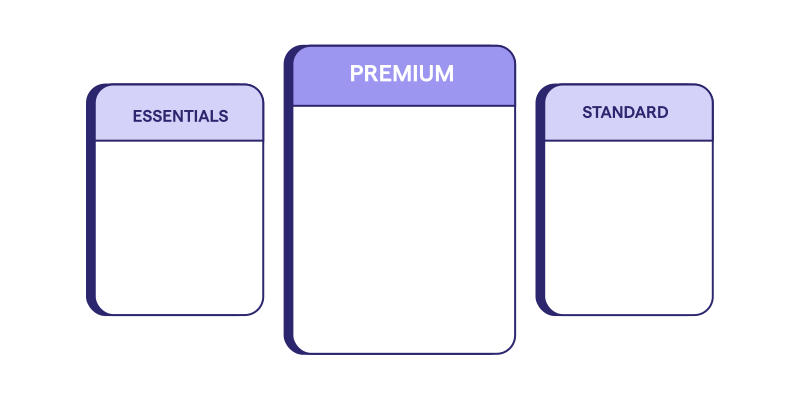
A tiered pricing strategy makes sense throughout professional services, including bookkeeping services. You could offer more than three tiers, but three is a good middle ground for most professional services businesses.
A three-tiered model looks like this:
- Essentials/Starter: Basic bookkeeping services (categorizing transactions, statement reconciliations, monthly balance sheet reports)
- Standard/Growth: Everything in tier one, plus additional services not everyone needs (accounts receivable tracking, bill entry, accounts payable scheduling)
- Premium/Full service: Everything in the previous tiers, plus concierge or strategic services (cash flow forecasting, custom financial reporting)
Each tier builds on the previous one, adding value and complexity. A system like this invites clients to choose the best fit option and shows them that you aren’t taking a one-size-fits-all approach.
For example, a small business that needs monthly bookkeeping can start with your modest essentials tier, while a client with complex financials who wants advisory services can scale up to your premium tier.
Make sure your packages also define deliverables and frequency.
Pro tip: Create clear, client-friendly service descriptions for each tier. Every client should be able to recognize what you’re including in a tier (and what you’re excluding).
Here’s a quick table with general examples of how a small bookkeeping business might divide its tiers:
| Essentials | Standard | Premium | |
| Services | Basic bookkeeping | Add AR tracking, bill entry, AP scheduling | Add strategic services |
| Response time | Within three business days | Within two business days | Within 24 hours |
| Reporting | Standard monthly reports | Standard reports | Custom reports targeting goals/KPIs |
Pricing made simple
Ignition simplifies tiered pricing with data-driven pricing insights.
Choose pricing models that protect margins
Working out your service tiers is an important step, but profitability matters just as much.
Even the best possible service tier structure doesn’t automatically mean healthy profit margins, so pricing strategy is just as important as the way you set up your bookkeeping service packages.
Instead of starting with “How many hours will this take?” build your pricing around the value you’re delivering.
(You’ll want to do the math in reverse as well, to make sure that your value-based price delivers a profitable per-hour rate.)
Another benefit of tiered pricing is psychological: when clients choose the package that best fits their needs, they feel in control. As they grow, upgrading to a higher tier is a natural response to that growth, not a custom negotiation or pushy upsell.
One more advantage: tiered upgrades make sales conversations easier. Instead of spending hours building bespoke quotes, you can focus on client needs and guide them toward the tier that truly fits.
Pro tip: Your practice keeps evolving and so do your costs, clients, and workload. Build annual price reviews into your process to account for inflation, operating costs, and client-side changes, like increased volume or added complexity.
Put guardrails on scope to stop creep
Scope creep is one of the biggest threats to profitability for service-based businesses—but it can also become a clear add-on opportunity.
When boundaries change mid-project or customers ask for “just one quick little thing,” that’s scope creep. Small requests you didn’t plan for (and didn’t charge for) add up and eat into profitability (not to mention morale).
This hit to profits is especially worrisome for businesses considering moving on from hours-based pricing.
Documentation is your first line of defense. Engagement letters should specifically name what you include and what you don’t, along with what elements trigger additional fees. Reinforce this documentation with clients using checklists or comparison tables that show what they get in each tier (and what they don’t).
You may not be able to eliminate scope creep. But you can turn those requests into business opportunities. When you turn extra services into clear, productized add-ons, you can point to them. Show the client that what they’re asking for is a clear departure from project scope—but still something you’re happy to do for them as an add-on.
Transparency is key:
- An add-on that sounds like an excuse doesn’t work.
- An add-on that’s clearly listed on your website or in your proposal as an optional extra is much easier to defend (and sell).
Automate proposals, billing, and renewals
Using a packaged service model works best when delivery and billing operations can support it with automation.
Manual proposals are a lot of work. Invoicing and renewals may take less effort, but as your client volume grows, this time adds up to an unsustainable amount.
Your new packaged services model already eliminates some of the manual proposal building that comes with bespoke, one-off proposals. But you’ll still face some manual tasks, including invoicing and renewals.
Automation is the lever for scaling without adding administrative overhead. Automation means you don’t have to manually process proposals, invoices, and renewals after setup. You can reassign the time you would’ve spent there on serving clients and bringing in new ones.
Ignition is a trusted platform that thousands of bookkeepers and accounting professionals use to automate the client lifecycle from proposal to renewal. AI-powered pricing insights, powerful templates, invoicing, billing, payments, and more come together in a unified platform built for pros like you.
Engagement letters and e-signatures
To reduce scope creep and contract disputes, back every package with a signed engagement letter that defines scope, pricing, and terms. This gives you a concrete reference point when questions arise around scope.
Manual pen-and-ink signatures slow the process down: clients have to print, sign, and scan, and you end up chasing signatures.
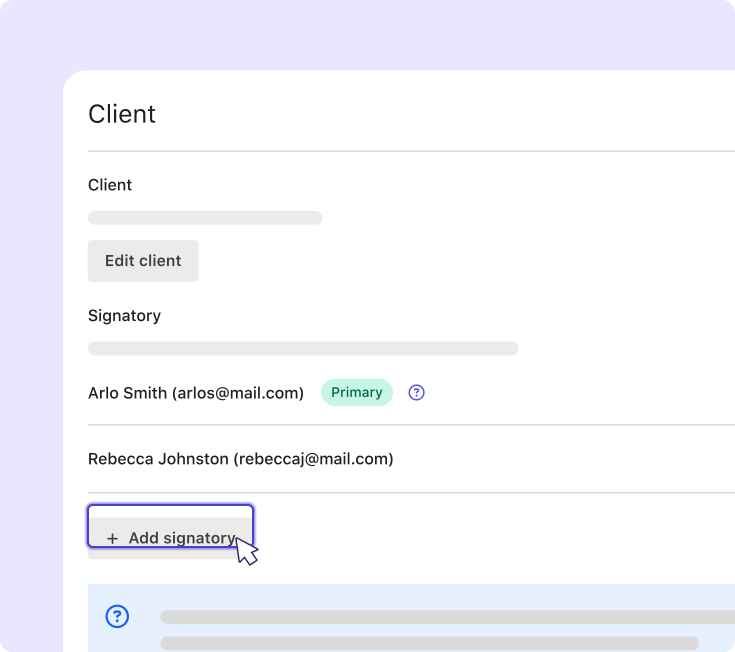
A process based on e-signatures removes this friction and streamlines your onboarding process. Ignition enables you to craft compelling digital proposals and collect e-signatures to keep deals moving.
And Ignition provides industry-vetted templates that help you reduce missed terms and keep you and your clients protected.
Recurring invoices and price reviews
Offering monthly packages works best when you can automate billing and maintain consistent cash flow. Without automation, manual invoicing can lead to delayed sends, missed payments, and time lost chasing receivables.
Ignition automates recurring billing and payment collection, freeing you up to focus on client work. Ignition also supports bulk renewals and annual price increases, so you can avoid revenue leakage over time.
Common mistakes when rolling out packages
If you’re making the switch from hourly billing to service-based packages, it’s normal to worry about making a misstep. Two reassuring thoughts:
First, your packages don’t need to be perfect at launch. Rolling out packages usually takes iteration and refinement.
Second, most significant mistakes happen when you launch too quickly and without clear documentation, well-defined boundaries, or thorough price analysis.
Here are a few common mistakes, plus how to avoid them:
- Generic or one-size-fits-all packages: Revisit your segmentation to break down your audience into smaller groups.
- Weak or nonexistent engagement letters: Use templates (Ignition has plenty) to catch missed language and create clear, comprehensive engagement letters.
- Pricing too low: Calculate based on value and check the math against your costs, capacity, and target margins. Ignition includes AI-powered pricing insights that help you price appropriately for your size and expertise.
- Vague service descriptions: Tighten language (use templates where possible) to give clients the clarity they need. Name deliverables and frequency explicitly.
- Fuzzy scope boundaries: Build clear guardrails into engagement letters and client-facing policies. Establish transparent add-on fees.
- Giving away too much in Tier 1: Revisit your basic offerings and make sure they’re sufficient and attractive for basic bookkeeping without giving away too much that you could charge more for.
Pro tip: If you’re worried about a hard launch, don’t do one. Start piloting packages with a smaller group of trusted clients. Where you find elements you missed or details that don’t line up, adjust them. Once your pilot group validates your package strategy, then you’re ready to roll it out to clients and prospects.
Turn packages into predictable revenue
Moving your bookkeeping business to a tiered package-based model unlocks clear advantages: income becomes more predictable, client expectations and relationships become better defined, and operations scale more effectively.
To build a system clients love, start with client segmentation. Then create tiered pricing structures, build scope guardrails, and automate all the admin.
Ignition gives bookkeepers and accountants one place to manage proposals, contracts, billing, and payments. Purpose-built for businesses like yours, Ignition helps reduce late payments and administrative overhead, helping you improve your cash flow and reduce time spent on admin. You can then spend more time delivering value and less time managing paperwork.
Ready to build tiered bookkeeping packages that convert?
Create tiered packages that you and your clients love.
FAQs
-
Segment clients by transaction volume and complexity, then build three tiers (essentials, standard, premium) with clear deliverables and caps. Put the scope and pricing in engagement letters and automate billing to keep delivery and payments consistent.
-
A basic package typically includes transaction categorization, bank and credit card reconciliations, and monthly P&L and balance sheet reporting for low-volume businesses. It should also include a clear monthly transaction cap to protect margins.
-
Estimate the work required for each client segment, then set flat monthly fees that reflect the value delivered and your costs. Add caps (like transactions or accounts) and review pricing annually as complexity and volume change.
-
Define what’s included and excluded for each tier, document limits in a signed engagement letter, and require approval for any out-of-scope work before starting. Clear caps and a consistent change-order process prevent unpaid extras.
-
Yes, offering priced add-ons like payroll, sales tax filing, or additional accounts gives clients flexibility without diluting your core packages. Add-ons also create a straightforward way to expand scope while protecting profitability.