How client advisory services make your firm indispensable



 Copied to clipboard.
Many firms have built their business around compliance work, only to find it eventually becomes an exhausting treadmill they can’t step off of.
Intense seasonal work cycles become grindingly predictable, while commoditized pricing starts to feel like a race to the bottom. Too often, clients see the work as a necessary expense versus a strategic investment, making it tough to stand out from the crowd.
But the business environment is shifting for everyone. Today’s commercial leaders have their own challenges, including faster business cycles, ongoing economic uncertainty, and an always-on digital culture. So they need more than just year-end numbers. They need a financial partner that understands their business.
Client advisory services (CAS) let you finally step off the compliance treadmill. CAS is all about delivering ongoing, strategic financial support to help clients turn their accounting data into meaningful, forward-looking insights. It covers areas like:
- Cash flow forecasting and scenario modeling
- KPI tracking and industry benchmarking
- Regular strategic check-ins that support real-time business decisions
Compliance work tends to be reactive, transactional, and seasonal, but CAS work is proactive, consultative, and (importantly!) continuous. So making the shift into client advisory work flips the whole dynamic.
Instead of a necessary expense, your firm becomes an indispensable partner, with deeper client relationships and recurring revenue streams you can price based on value delivered.
Firms that don’t keep pace risk being replaced by cheaper competitors or automation platforms.
Key takeaways
- Client advisory services shift accounting firms from seasonal compliance work to predictable, recurring revenue streams that stabilize cash flow year-round.
- Firms offering CAS report median growth rates of 16%, with premium pricing justified by the strategic value clients receive beyond basic bookkeeping and tax prep.
- Advisory relationships built on regular client interactions (often bi-weekly or weekly) create deeper loyalty and make price secondary to demonstrated value.
- Technology platforms that automate engagement letters, scope management, and billing unlock scalable CAS delivery without adding headcount.
1. Shifting revenue from seasonal spikes to recurring streams
Traditional accounting business models revolve around tax filing deadlines and year-end prep, creating the familiar feast-or-famine cycle that tests your staff's resilience as much as your cash flow. Moving into CAS lets you package services into predictable, subscription-based bundles that deliver more consistent monthly recurring revenue and smoother cash flow.
With more predictable revenue, you can make more confident, long-term investment decisions when the timing is right. No more putting off that new hire until peak season circles back around and you know business is still there.
Continuous CAS engagements also create more regular touchpoints with clients, which means more facetime and natural opportunities to meet new needs and strengthen the relationship.
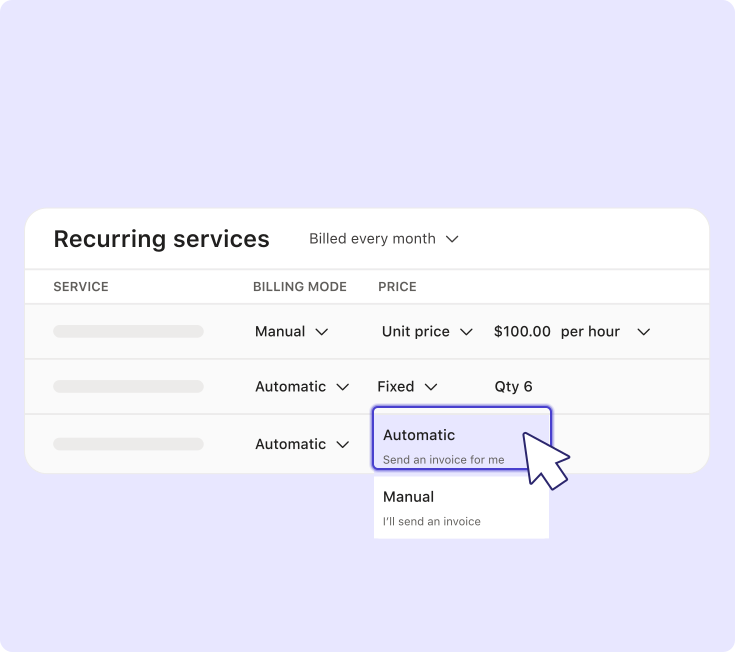
That said, recurring monthly services come with a bigger admin lift, so manual invoicing can’t keep up with a professional, scalable CAS offering. A tool like Ignition automates the entire invoicing life cycle (from initial proposals to automated renewals and payment collection) so payment admin doesn’t eat into your predictable revenue.

2. Deepening client loyalty through proactive insights
Regular weekly or bi-weekly meetings can build client relationships in a way that’s impossible when you only have a touchpoint at year-end or tax season. They also give you a chance to spot risks (like a looming cash-flow crunch) or opportunities (like repricing a service line) before they affect your client’s bottom line.
What’s more, being on-hand regularly as the trusted advisor creates stickiness. When you have historical context and a forward-looking vision, the cost of switching climbs. You move from an interchangeable vendor to an indispensable partner.
3. Commanding premium pricing for higher perceived value
Bookkeeping and tax preparation are now so commoditized that most SMB accounting firms can’t compete on price. With CAS services, your clients pay for outcomes, like better decisions, improved cash flow, or strategic foresight, not billable hours.
If you specialize in a niche industry or segment, that deep expertise commands premium rates. In CAS, rates reflect the value they deliver, not a markup on hours, which more than justifies the higher cost.
4. Differentiating in a crowded compliance market
Compliance services are so widely available, it’s virtually impossible for any one firm to stand out based on those offerings alone. But clients are increasingly looking for a strategic partner over transactional accounting.
CAS-based services like benchmarking, growth planning, CFO-style reporting, and proactive tax strategy planning let you showcase your firm’s expertise. It’s an effective way to pull in those higher-quality clients who value expertise and partnership over basic compliance.
Just remember that your operational infrastructure, including proposals, scope documentation, and billing, needs to match your new strategic positioning. Ignition brings those elements together in one workflow, so the client experience is consistent with the value you're delivering.
5. Stabilizing cash flow with subscription billing
Fixed-fee, subscription-style billing is a natural fit for CAS. Instead of the peaks and valleys of seasonal income, you get predictable monthly revenue that makes hiring decisions, investment planning, and day-to-day cash management so much easier.
Your clients benefit, too. They can budget for regular monthly fees instead of getting a big bill at the end of the year. Considering around half of B2B invoices are paid late, monthly billing can reduce payment delays and the friction that comes with them as well.
Subscription billing is a solid pricing tactic in general, but it’s also an infrastructure upgrade that can help your whole firm run like clockwork.
Ignition is built to operationalize the entire process, bundling proposals, billing, and payment collection into a single automated workflow — so your recurring revenue model actually stays recurring.
6. Elevating staff engagement with strategic work
For experienced accountants who’ve been through years of seasonal peaks, compliance work can feel like ticking off a checklist. CAS work offers more opportunities for the rewarding, impactful work that actually takes expertise and judgment.
This shift can make a real difference for retention. More valuable work, more client facetime, more chances to develop their skills. It all adds up to a better employee experience and a happier team.
AI and automation are making this transition more accessible too. Staff can surface insights faster and more confidently, expanding who can meaningfully contribute to advisory engagements. Plus, fewer but higher-value client relationships gives you a more sustainable workload, stopping the seasonal burnout that comes with a compliance-heavy roster.
7. Expanding wallet share via cross-selling opportunities
A quick email exchange about a tax filing has probably never surfaced any additional client needs. But that’s where CAS work shines.
A cash flow review might reveal invoicing bottlenecks or unfavorable payment terms. A budgeting conversation might expose gaps in succession planning or a tax position worth revisiting. Instead of feeling like forced upselling, it’s a natural extension of an ongoing conversation.
It’s also much more cost-effective to grow your firm by marketing advisory services to your existing clients than it is to invest in sourcing new clients, especially in a crowded compliance market. This makes CAS a strong lever for accountancies looking to drive up client spend.
8. Improving firm valuation and succession options
When it comes to valuing your accountancy firm, not all revenue is considered equal.
- Advisory revenue delivers high-value, predictable income, deeper client relationships, and a business that isn't dependent on tax season to survive.
- Compliance-heavy revenue is seasonal, transactional, and less predictable, which can look unattractive to potential buyers.
Advisory relationships also transfer easier, since they are built on a regular cadence, clear documentation, and ongoing value, not one-off engagements. Clients who’ve seen value and trust your firm are far less likely to walk away when ownership changes.
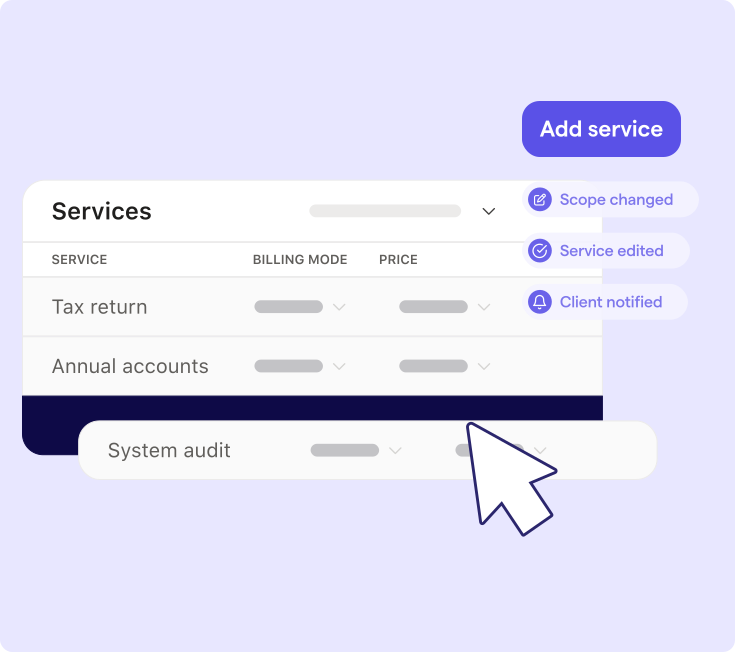
Engagement letter automation and scope documentation (both core capabilities of the Ignition platform) reinforce transferability, creating the paper trail that makes relationships portable and transition-ready.
Beyond a revenue play, CAS builds sustainable, long-term equity for your firm.
9. Future-proofing against automation of compliance tasks
AI and automation are already compressing the margins on compliance-based work and allowing more businesses to bring those tasks in-house. In fact, the number of accounting jobs asking for AI skills shot up 67% over the last year.
Firms increasingly use software to handle tasks like routine bookkeeping, tax preparation, and financial reporting. If your company relies on these services for core revenue, your runway is shrinking.
CAS gives you the space to navigate the changes, shifting your firm’s value to judgment, business context, and relationship-driven decision support, which automation can’t easily replace.
The firms building advisory capabilities now, while accelerating their routine work with automation, are compounding their advantage. They’ll already have the deeper client knowledge, stronger positioning, and more differentiated services competitors are just starting to explore.
Instead of fearing a future where automation replaces your core service offering, CAS gives you a proactive opportunity to get ahead and position your firm for long-term success.
How technology unlocks scalable CAS delivery
The biggest concern most accounting firms face is whether they have the capacity to deliver CAS consistently, without drowning in admin overhead. Technology reduces the operational complexity and makes the model sustainable and scalable over time:
- Integrated data and real-time dashboards mean advisory meetings can focus on interpretation and decisions instead of building reports.
- Tools like Ignition's engagement letter automation and scope documentation reinforce expectations upfront, for fewer "quick questions" that go unbilled and quietly erode your margins.
- Collecting payment details at the point of engagement and billing automatically protects the recurring revenue that makes CAS worth building in the first place.
The numbers reinforce why this matters. Platforms like Ignition can collect 91% of payments automatically, virtually eliminating receivables, and the administrative drag of chasing them.
Accelerate advisory billing and payments with Ignition
Ignition is the operational layer built for professional services firms, and it can help your accounting firm make a seamless transition to a CAS service provider. By combining proposals, engagement letters, automated billing, and payments in a single workflow, Ignition removes the admin friction that can make it hard to scale CAS.
For advisory practices, that means clearer scope documentation to prevent creep, automated renewals that capture annual price increases without awkward conversations, and integrated payments that eliminate receivables entirely.
Firms using Ignition report 24% average revenue growth and save 18 hours per week on admin tasks — valuable time that you can put back into client work, not paperwork.
Unlike generic billing tools adapted for accounting, Ignition is designed around how professional services firms actually operate.
Ready to move from compliance treadmill to indispensable trusted advisor?
Ignition is here to get you started.
FAQs
-
Firms of any size can offer advisory services, and solo practitioners or small firms often start by adding CAS to existing client relationships. The key is having capacity for regular check-ins and access to timely, reliable financial data.
-
Fixed or subscription pricing typically works best because it creates predictable revenue and keeps the focus on outcomes rather than time spent. Many firms use tiered monthly packages tied to specific deliverables and meeting cadence.
-
No specific certification is required, but credentials like CPA, CGMA, or industry designations can strengthen credibility. The most important factors are strong financial understanding, clear communication, and the ability to translate numbers into decisions.
-
Traditional accounting services are primarily compliance-focused, like bookkeeping, tax preparation, and financial statement preparation. CAS is forward-looking and centers on forecasting, planning, KPI management, and strategic decision support.
-
Use engagement letters that clearly define deliverables, meeting frequency, and what counts as out-of-scope work. Tools like Ignition help formalize changes and bill for add-on requests, which protects margins while keeping client relationships healthy.