How accounting firm automation eliminates scope creep



 Copied to clipboard.
Accounting firm automation has matured quickly. Most firms already use AI-powered tools for delivery, from pre-meeting prep to client onboarding.
The next high-return opportunity is in the proposal-to-payment workflow: the chain that determines whether the work you deliver gets billed. Professional services firms lose up to 5% of their earnings every year from revenue leakage.
In this context, accounting firm automation means using connected platforms and rules-based workflows to streamline how revenue flows through your firm, from the initial engagement letter to billing and collection.
If you're wondering where to start, focus on where the revenue leaks out.
Key takeaways
- Accounting firm automation helps prevent scope creep by defining services, pricing, and payment terms before work begins.
- When proposals, billing, and payments live in disconnected tools, automation can close the gaps where revenue leakage starts.
- Standardized engagement templates are often the first step in accounting firm automation because automation works best when the process is already clear.
- Accounting firm automation can make out-of-scope work billable by routing change orders into the same workflow as the original engagement.
- For many firms, automation improves more than efficiency; it can also support faster collections, steadier cash flow, and less billing reconciliation.
Scope creep is a billing control failure, not a client relationship problem
This scenario plays out in accounting firms every day: A client needs extra cleanup before their year-end close. The team handles it, assuming the conversation will come later. The advisory call runs long, so the follow-up email feels like the wrong moment to raise the issue.
Then the invoice goes out, and that extra work wasn't on it. The scope lived in a thread of emails and a mental note, but nothing was signed. That's a billing control failure.
Accounting firm automation works as the control layer between a proposal and a payment. Connecting scope, billing, and collections in one workflow makes extra work visible. And visible work is easier to review, approve, and bill.
What scope creep actually costs an accounting firm
Write-offs often get absorbed quietly — a few hours here, a task there. But over time, they create a heavy drag on your realization rate: the share of billable work that becomes actual billed revenue. That gap between hours delivered and revenue collected can be a clear indicator of firm health.
Many of the best-run firms closely monitor realization, including the share of delivered work that is billed. They track how long it takes to collect payments and watch revenue per partner. Scope creep puts intense pressure on all three.
The proposal-to-payment chain: Where scope creep enters the workflow
Every engagement moves through a chain of handoffs.
- A proposal becomes an agreement.
- The agreement guides delivery.
- Delivery generates an invoice.
- The invoice triggers payment.
But revenue leakage rarely happens inside a single step. It happens between them.
A proposal gets updated, but the change doesn't carry forward to the engagement letter. Delivery happens against a verbal scope that never made it into billing. By the time payment is due, the bill no longer reflects the work, and the firm absorbs the difference.
This is called the fragmentation tax: the extra cost, delay, and risk created when one workflow is split across disconnected tools.
When proposals are in one tool, billing in another, and payments somewhere else entirely, every handoff is a manual data entry point. Teams end up digging through emails and spreadsheets just to bill with confidence. The process slows, and revenue leaks out.
How disconnected tools compound the revenue leakage
Disconnected tools obscure ROI and make billing harder to trust. When a proposal changes in one system but invoicing happens in another, the link between agreed scope and billed revenue breaks.
Imagine updating a proposal after a scoping call, only to have billing time arrive weeks later. Since your invoicing is in a separate system, someone now has to manually reconcile the agreement with what your firm delivered. That means a time-consuming search through old email chains to piece together the original scope, long after the details have gone cold.
The compounding effect is a firm that consistently undercharges — by habit and by the path of least resistance.
How accounting firm automation closes each gap
Automation works best when the whole revenue cycle is connected. Point tools might improve individual steps, but a unified workflow closes the gaps and removes bottlenecks between them, from the initial scope through payment.
Ignition creates that end-to-end layer. It's a single cloud-based platform where proposals and engagement letters feed into billing and payment collection, making revenue leakage both detectable and stoppable.
Capture every dollar you earn.
Connect your proposals, billing, and payments in one platform, turning scope creep into recognized revenue.
Standardized engagement templates that define scope before work begins
Scope creep usually begins before a project kicks off. When scope exists only in conversations about deliverables, fees, and timing, ambiguity fills the gap. And ambiguity is where revenue gets absorbed.
Standardized engagement templates close that gap. By locking in deliverables, pricing, assumptions, exclusions, and payment terms, templates create a clear record that follows the engagement into billing. For recurring work (monthly bookkeeping, annual tax, ongoing advisory), that clarity multiplies across the client lifecycle.
Ignition's proposals and automated engagement letters provide that front-end control. Once a new client signs a proposal, it becomes your single source of truth for scope, pricing, and payment terms.
Automated change order workflows that make out-of-scope work billable
Out-of-scope work doesn't stop happening because a firm has a defined scope. Clients request cleanup that wasn't included. Payroll filings come in mid-engagement.
Extra work will arise. The biggest question is whether it gets billed.
Without a fast, low-friction way to issue a change order, you end up absorbing that work. Raising the conversation mid-engagement feels awkward, and rebuilding an agreement from scratch takes more time than the extra work is worth. So accounting professionals just write it off.
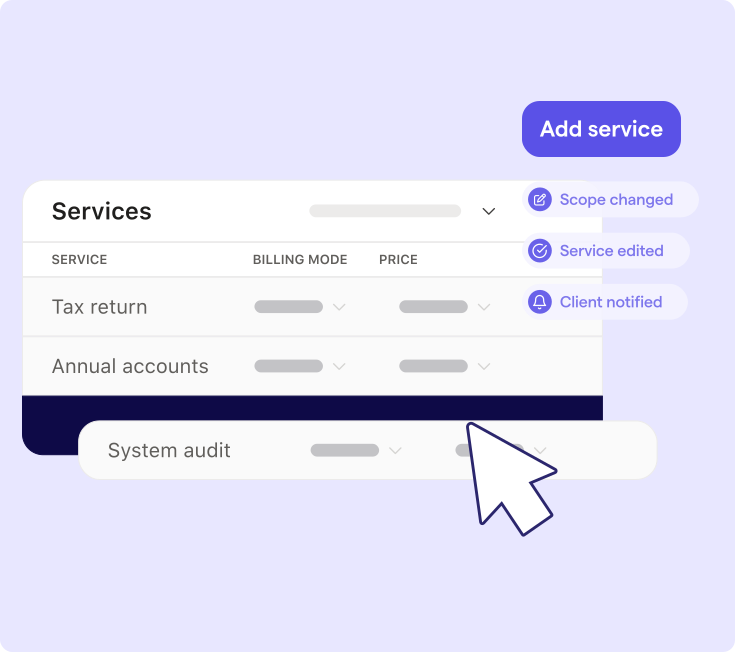
Ignition removes that friction. When extra work arises, you can issue a change order immediately through the same workflow as the original engagement — reviewed, approved, and billed, without starting over. Out-of-scope work becomes billable revenue.
Real-time project tracking that surfaces scope expansion as it happens
Project tracking often lives in a practice management system, which makes sense. But connected automation means status changes in one accounting system can trigger downstream actions in another, without adding more manual tasks.
For firms using Karbon, for example, an accepted proposal or an updated billing record can automatically flag scope expansion early. When a workflow status changes, it updates billing data and triggers next steps, so no one is stuck re-entering data across platforms.
Automated invoicing tied directly to the signed engagement
When invoicing is tied to the calendar instead of the engagement, the gap between delivery and billing grows. That's when scope drifts and revenue goes unbilled.
But when invoicing is automated and tied to the signed engagement, billing picks up what you agreed to at signature. Month-end invoices mirror your scope and terms by default.
Ignition's Smart Billing generates invoices from the accepted agreement to eliminate manual work, cut out reconciliation, and ensure nothing is left off the bill.
What firms actually gain when scope creep is automated away
Automation gains go beyond operational savings. They show up as recovered revenue and a cash position that supports better forecasting and reflects the work delivered.
Realization rate and revenue per partner are the headline measures, while days to collect and admin hours saved are the practical proof points. Connected automation should move everything you’re measuring in the right direction.
Revenue recovered from work that was previously absorbed
Monthly add-on work is where your profitability gets chipped away. Repetitive tasks and extra calls build up over time, and because they happen organically, they rarely make it to an invoice.
Change orders convert that absorbed work into recognized revenue. When you capture and bill extra work through the same workflow as the original engagement, it starts contributing to your top line. For recurring service relationships, that recovery builds across the client lifecycle.
Admin hours reclaimed from manual billing reconciliation
Uncollected revenue is only one part of the admin cost of scope creep. You spend time retyping the scope that was already written in the proposal and reconciling invoicing against engagement letters from months ago.
Automation helps optimize those admin hours. Advisory capacity is a competitive advantage, and the time your accounting team reclaims from billing reconciliation can be redeployed toward higher-value work.
Faster collection cycles and improved cash flow
Collection cycles slow down when billing starts late. When teams have to generate invoices manually at month-end, payment terms begin weeks after delivery. By then, the details are incomplete, and the client may already have questions.
Automated billing tied to agreement acceptance compresses that cycle. Billing starts when a client signs an engagement. Audit trails and transparent payment records give finance teams the visibility they need to verify collections, reducing room for error.
Stop absorbing work you never agreed to bill for
Scope creep is a billing control problem, and billing control problems have a specific workflow solution. When proposals connect to billing and billing connects to payment, you can close the gaps where revenue leaks.
Ignition handles that entire cycle seamlessly. An accepted proposal becomes an engagement. The engagement drives billing. Billing triggers payment. Every step stays connected.
Stop scope creep from becoming lost revenue
Ignition connects proposals, engagement letters, billing, and payments in one workflow.
FAQs
-
Start with the proposal-to-payment workflow, because it touches your core accounting processes—scope, billing, and cash flow—in one chain. When proposals, engagement terms, recurring billing, and payments stay connected, fewer handoffs create fewer missed charges. That usually gives small firms the fastest operational win before expanding into tax, reconciliation, or document collection automation.
-
Accounting firm automation reduces scope creep by defining services upfront and tying work to signed engagement terms. Standardized templates and change workflows make extra work visible before it’s absorbed into delivery. With Ignition, CPA firms and bookkeepers can turn approved scope changes into billable work without having to rebuild the client agreement from scratch.
-
The return often comes from recovered revenue, fewer write-offs, faster collections, and less manual billing reconciliation. Many firms also gain capacity without adding headcount, which may improve margins even when client demand keeps rising. Track realization, collection time, and admin hours saved so the investment is measured against firm outcomes, not just feature usage.
-
Implementation is usually faster when the firm standardizes services, pricing, and billing rules before configuring any platform. A phased rollout supports scalability and works well for most firms, starting with one service line or one recurring workflow. That approach may help teams adopt new automated processes with less disruption and fewer workarounds.
-
The cleanest setup connects proposals, signed terms, recurring billing, and payment collection in one workflow. That reduces double entry, shortens collection cycles, and helps prevent invoices from drifting away from the agreed scope. If you use accounting software like QuickBooks or Xero, Ignition can act as the automation layer between client acceptance and payment.