Best agency billing automation software: 6 tools compared
Compare six tools to find the best agency billing automation software, including how Ignition's proposal-to-payment model differs from NetSuite.


 Copied to clipboard.
An operations lead runs payroll through Gusto, reconciles the books in Xero, and still spends Friday afternoons chasing three clients for last month's invoice. The accounting platform handles bookkeeping without complaint, but it was never built to collect payment authorization the moment a proposal gets signed, or to bill instantly when a project runs past its original scope.
That costs money. Around 57% of U.S. marketing agencies lose between $1,000 and $5,000 a month to unbilled scope creep, according to Ignition's 2025 agency pricing and cash flow report.
Agency billing automation software is a platform that connects signed client agreements directly to automatic invoicing and payment collection, removing fee calculations and payment follow-up for firms billing recurring and project-based work.
Finding the best agency billing automation software starts with understanding how purpose-built billing for professional services beats billing bolted onto a generic accounting suite or an enterprise resource planning (ERP) platform like NetSuite, which is built for broad financial operations. The comparison below measures six platforms against that standard, so the choice comes down to fit for your agency.
Key Takeaways
- Collecting payment authorization at proposal signing can meaningfully reduce late payments for your agency.
- Many agencies still absorb scope-creep costs they could bill immediately, which quietly erodes project margin.
- Xero and QuickBooks handle bookkeeping well, but they weren't built to automate payment collection tied to signed proposals.
- Agencies billing headcount-based or payroll-linked fees often recalculate charges by hand every billing cycle.
- Billing processes tend to break down once an agency manages more than about 30 recurring clients.
The proposal-to-payment test behind this list
The decisive test behind this comparison is whether a platform authorizes billing and collection the moment a proposal is signed.
Apply that test to four kinds of tools:
- Purpose-built billing platforms
- Accounting layers
- Work-management tools
- Generic ERP systems
The professional services automation market is set to reach $28.73 billion by 2031, at an 11.17% compound annual growth rate (CAGR), which shows purpose-built billing is gaining ground fast.
Ignition
Ignition is the only platform on this list built around collecting payment authorization as soon as a proposal gets signed. That signed scope becomes the source of truth for billing. Recurring retainers, variable fees, and out-of-scope charges all trace back to what your client actually agreed to.
Xero, QuickBooks Online, and Gusto stay in the picture as connected platforms that feed data into Ignition. This kind of business automation for professional services removes the gap between what's scoped and what's billed.
In practice, around 78% of Ignition customers report reduced late payments because the payment ask never has to happen as a separate, awkward conversation. Authorization is already on file. For a closer look at how the workflow runs end to end, watch this walkthrough.
Xero
Xero handles agency accounting well, but it wasn’t built to run proposal-to-payment billing. That missing piece shows up in three specific ways:
- Xero doesn’t capture payment authorization at the proposal stage, so you still chase a separate payment step after the client signs.
- Scope creep still takes a separate invoice to process, since there’s no built-in workflow to charge for out-of-scope work on the spot.
- Price updates and variable fees tied to headcount or usage still get calculated and applied client by client.
For agencies formalizing retainer and subscription pricing, this guide to agency subscription billing best practices is a useful starting point.
QuickBooks
QuickBooks stays in the stack as the bookkeeping layer. It handles the ledger, the reconciliation, and the accounting side of running your agency.
Where it falls short is payment authorization tied to a signed agreement. QuickBooks sends automated invoice reminders after an invoice goes out, but there's no step that captures payment details when a client signs on.
If your QuickBooks Online invoices are piling up unpaid, AutoCollect pulls those outstanding balances into an automated collection workflow.
AI tools can transform how firms bill and collect
Watch the webinar on the tools accounting and agency firms are using to simplify billing.
Ravetree
Ravetree treats billing as one module inside a broader work management platform built for agencies running projects, resources, and client work in one place. Invoicing sits alongside project tracking and resource planning.
Against the proposal-to-payment test, that structure matters. A signed proposal doesn’t automatically become an authorized, collectible invoice inside Ravetree’s billing module.
The platform’s published material also doesn’t detail how it handles recurring retainer automation or the depth of its Xero or QuickBooks connections, which is a consideration for agencies relying on those tools for accounting.
If your agency needs broad project and resource management alongside invoicing, Ravetree may fit. If you need billing tied directly to what was scoped and signed, you need a platform built specifically for that job. Ignition takes the opposite approach and stays narrowly focused on the full lifecycle, from signed agreement to automated billing and payment collection.
Plutio
Project management and invoicing are the core of Plutio, which sits in a different category from proposal-to-payment tools like Ignition. It’s built around managing agency work, with invoicing sitting alongside tasks, time tracking, and client communication. Proposals can generate invoices with payment stages and deposit collection at signing, though the platform is project-focused rather than billing-first.
On the criteria that matter most for agency billing, Plutio’s positioning centers on retainer and project invoicing. While it does have a proposal workflow, it’s not the product’s main focus.
That matters if you’re chasing approvals or delayed payments. Ignition connects the signed proposal, the billing schedule, and the payment authorization in one workflow, so added scope becomes an immediate charge.
NetSuite
Built for larger organizations with complex operational needs, NetSuite is an ERP system for broad financial operations across an entire business. It handles general ledger, revenue recognition, and financial reporting at that scale.
That breadth becomes a liability once an agency’s billing gets specific. Charging a headcount-based retainer fee tied to payroll data, automating collections on overdue invoices, or billing for out-of-scope work the moment it happens all take custom configuration or development inside NetSuite. None of those workflows come ready-made for how agencies actually bill.
This isn’t a knock on NetSuite as a system. It’s simply not built to connect a signed agreement directly to recurring and variable billing without extra engineering. If your agency manages that complexity, you need a platform purpose-built for it.
AutoCollect, AutoPricing, and Smart Billing
Ignition’s AutoCollect, AutoPricing, and Smart Billing solve three distinct billing bottlenecks. Chasing overdue invoices, updating prices client by client, and recalculating headcount-based fees each month are separate tasks with separate fixes.
Before automation, you might spend hours a month on each of these tasks. After, all three run without anyone needing to step in.
AutoCollect clears outstanding invoice backlogs
AutoCollect imports outstanding Xero or QuickBooks Online invoices directly into Ignition's automated collection workflow, replacing the work of manually chasing overdue client balances.
Your agency imports the whole outstanding backlog into Ignition in one pass, so no one has to pull up each unpaid invoice and email a reminder or, worse, call a client to ask about payment. From there, the automated sequence handles the follow-up, so nobody on the team is repeating the same awkward conversation client after client.
This matters because the scale of the problem is bigger than most agencies assume: 43% of credit-based B2B sales in the U.S. are overdue.
AutoPricing applies fee increases at scale
AutoPricing applies fee increases across many client accounts at once, replacing the need to update each client's price individually.
Without it, a fee increase means opening every client record, editing the amount, and saving the change one at a time. That's manageable with a handful of clients. It becomes a multi-day task once your agency has 50 or more accounts on the books.
Agencies typically run price increases at renewal, often on the same annual cycle.
AutoPricing turns that renewal cycle into a single bulk action, applied across the client base in one pass.
Smart Billing automates payroll-linked fees
Smart Billing uses data synced from Gusto, Xero, and QuickBooks Online to calculate headcount-based or variable fees automatically. Each billing cycle, it pulls the latest numbers from whichever platform a client's payroll or transactions run through.
The workflow runs in sequence:
- Gusto reports headcount changes.
- Xero or QuickBooks Online confirms transaction volume.
- Smart Billing applies that data to the fee structure set in the client’s agreement.
No one on the team opens a spreadsheet to recalculate anything.
For an agency billing a client based on staff count, this addresses an issue that manual processes leave open. A client adds three employees mid-month, Gusto reflects the change, and the next invoice reflects it too, without a finance lead cross-checking payroll reports before sending a bill.
Comparing integration depth and scope-creep billing
The strongest agency billing fit comes down to two questions: Do the platform's integrations actually drive billing decisions, and can added scope get billed the moment it happens? Set side by side, the real differences show up less in what each tool calls itself and more in what it was built to automate.
Evaluation factor | Ignition | Xero | QuickBooks | Ravetree | Plutio | NetSuite |
| Purpose-built for professional services billing | Purpose-built for professional services and agency billing | General accounting platform, not agency-specific | General accounting platform, not agency-specific | Work management platform with an integrated billing module; not billing-first | Agency work management platform with billing alongside tasks, time tracking, and CRM | Enterprise ERP built for broad financial operations |
| Proposal-to-payment automation | Collects payment authorization at proposal signing | No proposal-linked payment authorization | No proposal-linked payment authorization | Client-approved estimates can trigger auto-invoicing on retainers via Stripe; no scope-tied payment authorization at signing | Proposals can auto-create invoices with payment stages and deposit collection at signing; project-focused rather than billing-first | No proposal-linked payment authorization |
| Automated collections for outstanding invoices | AutoCollect imports Xero and QuickBooks Online invoices into automated collections | Manual follow-up with recurring invoice reminders | Automated invoice reminder emails only | Clients can pay via Stripe; no dedicated automated collection workflow for overdue balances | Automated payment reminders via Stripe, PayPal, and Square; no dedicated outstanding invoice collection workflow | Custom configuration for automated collections |
| Variable, payroll-linked billing | Smart Billing auto-calculates fees from Gusto payroll data | No native payroll-linked billing | No native payroll-linked billing | Supports time-based, milestone, and bill-rate invoicing; no native payroll-linked billing | Milestone and hourly invoicing supported; no native payroll-linked billing | Payroll-linked billing needs custom development |
| Bulk fee increases across client base | AutoPricing applies fee increases across many clients at once | Price updates handled one client at a time | Price updates handled one client at a time | No dedicated bulk fee increase tool across client base | No dedicated bulk fee increase tool across client base | No dedicated bulk pricing tool for service fees |
| Scope-creep and out-of-scope billing | Instant Bill charges for out-of-scope work on the spot | No dedicated out-of-scope billing workflow | No dedicated out-of-scope billing workflow | Invoices can be created from approved time logs and expenses; no dedicated instant out-of-scope billing feature | Invoices can be generated from tracked time and milestones; no dedicated instant out-of-scope billing workflow | Manual invoice creation for added scope |
NetSuite and generic accounting platforms like Xero or QuickBooks sync financial data well, but neither ties a signed agreement directly to what gets billed each month. That’s most relevant in the scope-creep row.
Scope creep = margin disappearing. A platform that turns out-of-scope work into an immediate charge protects revenue that would otherwise vanish into goodwill.
Matching platform choice to billing complexity
Agency platform fit comes down to three factors:
- Client volume
- Integration depth
- How variable or added-scope billing gets handled
If you're managing recurring retainers alongside project fees across dozens of client accounts, a generic invoicing setup won't hold up.
The three checkpoints below test each factor separately. For a broader breakdown of what automated billing should handle, see this guide to automating your billing process.
Match automation needs to your client count
Manual collection becomes a significant drain once your agency crosses roughly 30 recurring clients, and mixed billing complexity intensifies further at around 50 clients handling a combination of retainers and variable fees.
Payment delays compound at that scale. U.S. small businesses waited an average of 29.3 days to be paid, with 8.5 days of those days classified as late. Multiply that lag across 30 or more client accounts, each needing its own follow-up, and the hours lost to chasing invoices add up fast.
Count your own accounts before assuming your current workflows will hold. Separate recurring retainer clients from variable or project-based ones, since both categories carry their own automation demands.
Check integration depth with Xero, QuickBooks, Gusto
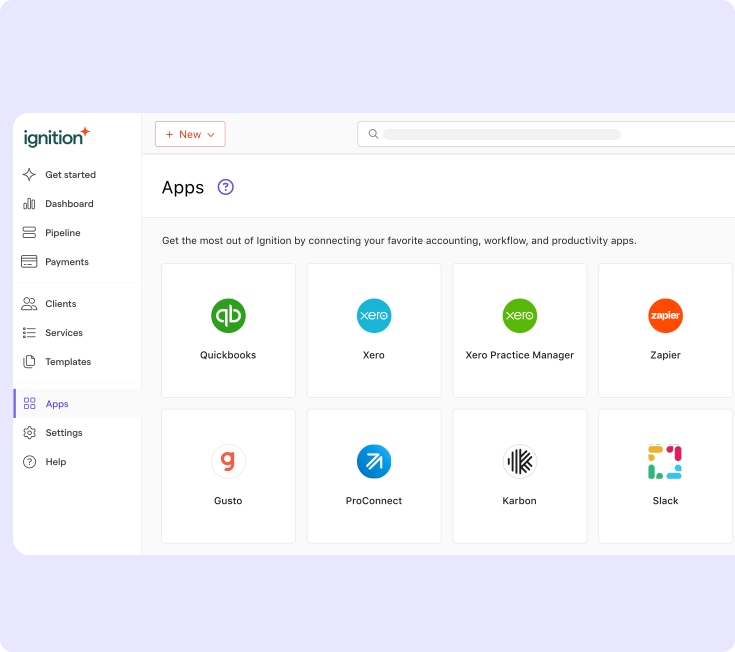
Integration depth determines whether billing pulls directly from signed agreements and payroll data. A basic connection moves records back and forth. A deep one uses that data to act by:
- Importing outstanding invoices
- Reconciling payments automatically
- Calculating a variable fee based on headcount without anyone opening a spreadsheet
Test each connection on its own workflow. With Xero or QuickBooks, check the collection workflow. For the Gusto workflow, see this breakdown of automated billing workflows.
Confirm scope creep and variable billing handling
The real scalability test is whether a platform can bill for out-of-scope work immediately.
Without a dedicated workflow, added scope stalls on a separately built invoice:
- Writing a description
- Matching it to the original agreement
- Sending it
- Waiting for payment
After a client approves added work through Ignition's Instant Bill, the charge goes out on the spot, tied directly to that client relationship and already authorized for payment.
Run this workflow test alongside your recurring and variable fee checks. A platform that passes all three checks (client volume, integration depth, and instant scope-creep billing) is built for how agencies actually work.
Purpose-built billing turns proposals into work
A firm billing 50 clients on a mix of retainers and headcount-based fees doesn't need another accounting tool bolted onto its stack. It needs billing that already knows what was scoped, priced, and signed, because that agreement is the source of truth for every invoice that follows.
That's the practical shift worth making this week. Stop treating billing as a spreadsheet exercise that happens after the work, and start treating the signed proposal as the trigger for payment authorization, scope-creep billing, and connected accounting data.
Proposals, billing, and payments were never meant to live in separate systems.
Connect proposals to automatic billing
Proposals, billing, and payments belong in one system. Test the workflow and see how fast payment follows a signature.
Frequently asked questions
-
Most agencies can connect their accounting software and import existing client agreements within a few days. The bulk of setup time goes toward mapping recurring retainers and variable fee structures into the new system. Once proposals and billing templates are in place, ongoing invoicing and collection run automatically without further setup work.
-
Smaller agencies can still benefit, particularly if they bill a mix of retainers and project work that involves frequent scope changes. The time savings become more dramatic as client count grows, but even a handful of clients on variable or headcount-based fees can justify automating billing. Agencies planning to scale past 30 or 50 clients may find it easier to adopt automated billing early, before those habits become hard to change.
-
Purpose-built billing platforms link every charge back to the signed proposal that authorized it, giving agencies clear documentation to resolve disputes quickly. Because the client already agreed to pricing and payment terms at signing, disputes tend to be less frequent than with after-the-fact invoicing. Ignition’s proposal-to-payment model keeps that authorization record attached to every transaction, helping agencies respond to disputes with confidence.
-
Billing automation software handles invoicing, payment collection, and fee calculations. Financial reporting and compliance judgment still sit with your accountant. These platforms typically sync with accounting software like Xero or QuickBooks, feeding accurate billing data into the books an accountant already manages. The result is less manual reconciliation work for your accounting staff, while their role stays intact.
-
Pricing for agency billing automation platforms generally scales with client count or the complexity of billing workflows. Agencies with a simple recurring retainer model often pay less than those needing variable, project-based, or payroll-linked billing across dozens of clients. Firms evaluating options should confirm current pricing directly with each vendor, since plans and tiers can change over time.